


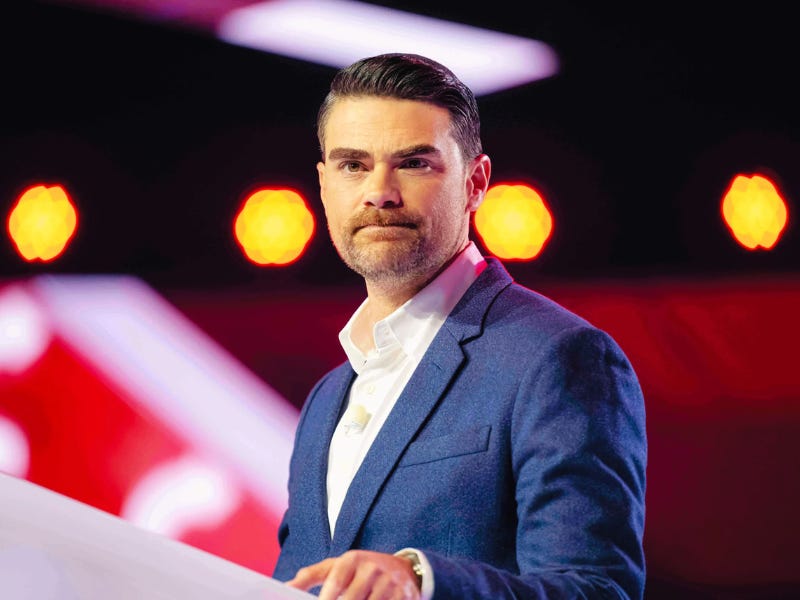
These days, the term “Never Trumper” is mostly used a pejorative on the political Right. The MAGA-verse slaps the label on just about any former or current Republican who offers choice words for our president. The more traditional conservatives, who use it, reserve the term for Lincoln Project types who are always happy to twist themselves into intellectual or ideological pretzels just to get on the opposite side of an issue as Donald Trump.
But back in 2016, the term had an identifiable, much more narrow meaning. It was a self-assigned title for Republicans and conservatives who refused to vote for Donald Trump in both the primary and general elections that year. Their reasons varied, as did their choice of who they ended up throwing their electoral support behind (if anyone). But in just about every case, their decision was rooted in principle.
Principles Over Party
One of the more prominent Never Trumpers at the time was conservative commentator, Ben Shapiro. Shapiro wanted nothing to do with Trump. He viewed the celebrity businessman as dangerous to both the Republican Party and the country. He even left his longtime employer, Breitbart News, over their decision to serve as a Trump “fan-girl site” (Shapiro’s words), and campaign-arm for the candidate… even after Corey Lewandowski (Trump’s campaign manager at the time) physically roughed up Breitbart reporter, Michelle Fields.
Shapiro offered a number of reasons for why he couldn’t never pull the lever for Trump, but a big one had to do with the effect Trump’s ascendance would have on (and was already having on) the conservative movement.
“I think that he’s already hurt conservatism pretty badly,” Shapiro told CNN host Larry King, just a couple months before the general election.
Much to Shapiro’s dismay, Trump had locked up the Republican presidential primary that spring, defeating a bloated field of impressive, conservative candidates with angry, personality-fueled bluster, breathtaking dishonesty, wild conspiracy theories, blatant bigotry, and a populist, big-government platform.
Shapiro believed, as many people did at the time (including Trump himself), that Hillary Clinton was going to win. Shapiro likewise couldn’t stand Clinton, knew she was bad for conservatism, and wasn’t going to vote for her either. But with a Republican Congress sure to serve as a check on her power, he was more worried about the fate of conservatism if she lost.
“I’m concerned that [Trump] hurts conservatism if he wins,” Shapiro told King. “Because then, you see this whole group of people who sort of follow him, position to position, based on loyalty to party and loyalty to him personally… That’s a serious concern to me.”
In other words, his fear was that if Trump won, Republicans and conservatives would do nothing to stand in his way. They would not serve as gatekeepers of conservatism, the Constitution, our institutions, and even just basic decency… the way they assuredly would if Clinton were president.
A few months earlier, before Trump had secured the nomination, Shapiro, warned (in a piece that began with “I will never vote for Donald Trump. Ever.”):
“If we don’t say ‘no’ to Donald Trump now, we will continue drifting ever further left, diluting conservatism into the vacillating, demagogic absurdity of Trumpism. Conservatism will become the crypto-racist, pseudo-strong, quasi-tyrannical, toxic brew leftists have always accused it of being.”
Foretelling Confirmed
Well, as it turned out, the Ben Shapiro of 2016 was a prophet — not on Donald Trump’s electoral viability, but pretty much everything else. The brand of American conservatism he knew, promoted, and defended now lies in shambles. Today’s Republican Party has surrendered nearly every tenet of pre-Trump conservatism to the ego and whims of one man.
The leader of the party that traditionally stood for lower taxes has unilaterally imposed the largest U.S. tax increase as a percent of GDP in over 30 years (larger than both Obama and Biden).
The leader of the party that long preached about fiscal responsibility, and the dangers of runaway spending, has already signed into law — in just five years — $13 trillion in debt (dwarfing every other U.S. president’s debt contribution, with trillions more to be added by the time he leaves office).
The leader of the “free trade” and “free market” party has instituted crushing, largely indiscriminate tariffs that are costing Americans jobs, sidelining American businesses, destroying our relationships with international trade partners, driving up the average U.S. household’s cost of living by thousands of dollars, hiking government subsidies through the roof, and taking government equity stakes in private companies.
Deference to the Constitution is now scoffed at by many on the right, including top figures in the administration. The Justice Department views the settling of our president’s personal scores as one of its key functions. The pro-life movement has effectively been abandoned. The party whose former president defeated the Soviet Union is now watching their current president try, over and over again, to surrender Ukraine to its Russian invaders. The party that once valued character and objective truth is now dominated by morally corrupt vulgarians, demagogues, and conspiracy theorists.
Some of you may remember Ben Shapiro’s most famous quote (that predates the Trump era): “Facts don’t care about your feelings.”
The often repeated phrase was largely a shot at the political Left in our country, whose ideology is heavily driven by emotions rather than truth, logic, or legal rights.
Sadly, much of today’s Right also prioritizes their feelings high above facts, latching onto just about every baseless narrative or conspiracy theory that confirms their biases, and offers an alternate explanation for why their side isn’t to blame for any of society’s woes.
Shapiro, however, hasn’t been a helpless witness to all that has come to pass. In some ways, he’s contributed to the problem.
The Capitulations
Shapiro understood, after Trump won the presidency in 2016, that his conservative media company, The Daily Wire (which was barely a year old at the time), couldn’t survive unless it became a MAGA-friendly institution that appealed to the New Right’s increasingly tribal instincts. He therefore muted much of his criticism of Trump and Trumpism, focused on the select conservative wins Trump produced, reserved his most impassioned disagreements for the Left, and added a number of conspiracy-peddling, right-wing firebrands, social-provocateurs, and bad-faith actors to his payroll (including the now infamous Candace Owens).
Shapiro didn’t personally go as far down the rabbit hole as a number of his employees and right-wing media competitors. But his reluctance to anger a good portion of his audience by telling them what they needed to hear, instead of what they wanted to hear, compelled him to let go of some once unwavering principles (along with some of his integrity).
He stayed silent on issues he shouldn't have, and rationalized conduct the old Ben Shapiro wouldn’t have. By election day of 2020, he’d become an outspoken Trump supporter, reneging on his vow from four years earlier never to vote for the man.
In fairness to Shapiro, many of the worst predictions for Trump’s first term hadn’t come to pass by 2020. Members of Trump’s administration, mostly made up of traditional Republicans, had successfully steered the president away from his worst impulses. The conservative movement got some good Supreme Court justices out of that term, and the tilt of the court has already paid significant conservative dividends. There were other conservative achievements to speak of as well.
But Trump’s conduct after losing to Joe Biden changed everything — or at least it should have. Trump’s efforts to overturn a national election to stay in power, and his provocation of a deadly insurrection at the U.S. Capitol, had proven even his strongest critics correct. Yet, after years of election denialism, false-flag conspiracy theories, and memory holing that resurrected Trump’s political viability, Shapiro endorsed him once again for president in 2024. He even co-hosted a fundraiser for Trump.
But not long after Trump returned to power earlier this year, something changed in Shapiro. A reinvigorated Right seemed to bring with it the long overdue realization of just how ugly and extreme growing factions on his side of the aisle had become. Years without gatekeeping, and the bastardization of intellectualism, had led to antisemitism, nativism, and anti-Americanism firmly taking root — regularly boosted by some of the country’s most popular right-wing podcasters (including Tucker Carlson and Shapiro’s former employee, Candace Owens).
The conspiracy culture had spiraled further out of control, reaching the point that Charlie Kirk’s assassination was being blamed on “the Jews” and even Kirk’s grieving widow, Erika.
The Reawakening
It’s not clear what the final straw was for Shapiro. Maybe it was the increasing attacks Tucker Carlson had leveled on Israel, Jews, and Shapiro himself. Maybe it was the calls after Kirk’s murder from prominent right-wing influencers (including Matt Walsh, one of Shapiro’s employees) to unite with the most extreme elements of the right, including antisemites and white supremacists. Maybe it was the refusal of “conservative” think-tanks like the Heritage Foundation to stand up to any of it.
Whatever the catalyst, Shapiro has been on a mission in recent weeks to, as he did in 2016, draw a line in the sand between the conservative movement he wants, and the nasty byproducts of the rudderless ship it has become. His efforts were highlighted by two high-profile speeches he delivered last week — one to the aforementioned Heritage Foundation and one to the late Charlie Kirk’s organization, TPUSA.
Both organizations still identify as “conservative,” and list conservative ideals in their mission statements, but they’ve become extremely poor representatives of such. They’ve chosen instead to attach themselves to right-wing movements and individuals that are downright hostile toward conservatism.
Case in point, in looking at TPUSA’s AmericaFest event from last week, one would be hard-pressed to find a single speaker, other than Shapiro, who still argues in defense of conservatism. Heck, you would have had trouble finding anyone — again, other than Shapiro — who is less afraid of publicly opposing right-wing antisemitism (and those who platform it), than publicly opposing someone like Mitt Romney, Liz Cheney, or even Mitch McConnell.
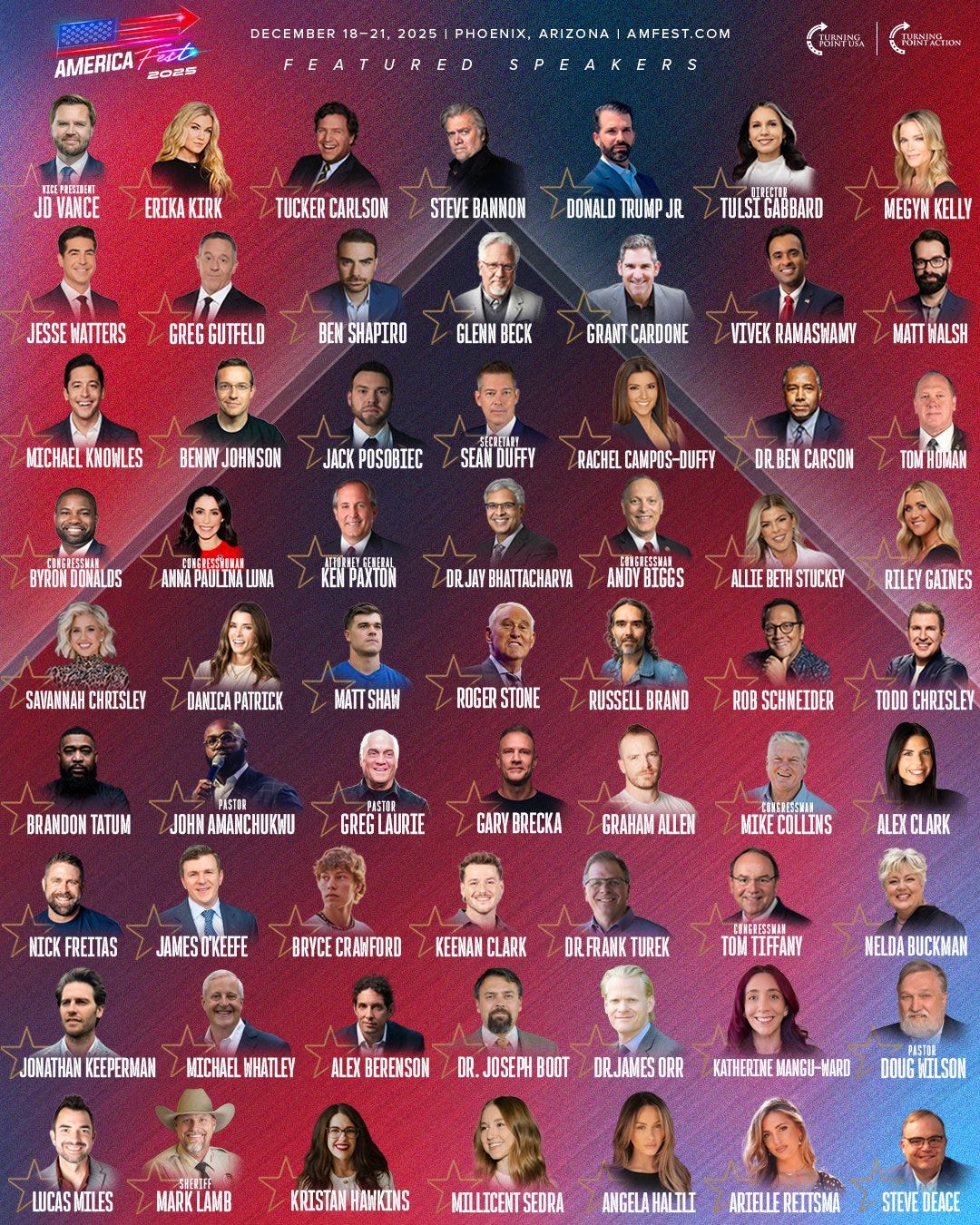
That’s why it took real guts for Shapiro to deliver the speech that he did in front of the TPUSA crowd.
The Truth
“The future of the country relies on the future of the conservative movement,” Shapiro’s speech began. “It relies on what TPUSA defines as its core mission: freedom, free markets, and limited government. And it relies, most of all, on truth. Because victory—true victory—cannot be achieved without truth. Victory without truth is victory for a lie. And that is no victory at all. And unity without truth is no unity. It is merely solidarity in falsehood.”
Those few short sentences alone were an evisceration of just about every other featured speaker at the event — a collection of mostly grifters, conspiracists, and other bad-faith actors who’ve reached new professional heights in the Trump era by perverting the truth.
But Shapiro was just getting started. After preaching the virtues of free markets, traditional values, limited government, and a foreign policy based on principles, he returned to the importance of truth:
“But I want to talk about something even more important: how to discern those attempting to speak truth from frauds and grifters.
Because something is new: an informational environment rife with both opportunity and chaos. Opportunity, because the legacy media gatekeepers are no longer in charge of what we see and hear. And chaos, because an anarchic informational environment means that we must be smart in how we assess the information and arguments we hear.
Why does this matter? Because today, the conservative movement is in serious danger. It is in danger not just from a left that all too frequently excuses everything up to and including murder. The conservative movement is also in danger from charlatans who claim to speak in the name of principle but actually traffic in conspiracism and dishonesty, who offer nothing but bile and despair, who seek to undermine fundamental principles of conservatism by championing enervation and grievance. These people are frauds, and they are grifters. And they are something worse: a danger to the only movement capable of stopping the left from wrecking the country wholesale.”
Shapiro continued, presenting five “obligations” (Shapiro views them as duties) that speakers on the American political Right owe their readers and listeners. The first one was truth:
“We owe you the truth. That means we should not mislead you; it means we shouldn’t hide the ball; we shouldn’t be deliberately obscure about what we are telling you. We have an obligation to clarity and to honesty.
This means that we must be clear in our language. We should not traffic in generality. We should not say things like ‘they’ shot Charlie without specifying what we mean by ‘they.’”
Shapiro argued that those who throw out the word “they” in such situations are “trafficking in vagary that results in increased hatred without proposing any effective response. They are fostering despair and rage. And that makes everything worse.”
He added, “We must not let fear of audience anger deter us from telling the truth; we must not let fear of other hosts deter us from telling the truth.”
He named names, calling out Candace Owens for brutally conspiracizing Charlie Kirk’s death, along with the cowardice of prominent right-wing media figures who’ve remained silent on the matter.
Principles Over Feelings
Shapiro’s second obligation was to “speak out of principle, not personal feeling”:
“It should not matter whether we ‘despise’ someone or ‘love’ them. The question is what they say and do, and whether those things are morally decent or not. On a political level, do they foster freedom, justice, and prosperity? On a personal level, do they treat others as they would wish to be treated? Personal feeling is not a substitute for moral judgment.”
Shapiro returned to the Candace Owens example, saying “friendship with public figures who do or say evil things is not an excuse for silence on the matter. Politics isn’t The Sisterhood of the Traveling Pants. Politics is about principle. And if you are willing to sacrifice basic truth and simple principle in favor of emotional solidarity, you have betrayed your fundamental duty to the American people.”
Shapiro identified Tucker Carlson and Megyn Kelly as two of the individuals refusing to condemn Owens out of a proclaimed personal affection for her.
Personal Responsibility
“We have a duty to take responsibility for what we say and do,” said Shapiro, presenting his third obligation. Evoking Owens again, he added, “If we hire awful people, we are responsible for that—and I have some experience there, as you might suspect. That means that if we offer a guest for your viewing, we owe it to you to ask the kinds of questions that get at the truth. If we agree with the guest, that’s fine—but we should own it.”
He then let loose on another individual: Nick Fuentes. He quoted some of Fuentes’s most abhorrently bigoted statements, including some he made against prominent figures on the American right. He chided Tucker Carlson for using his show to build Fuentes up, “glazing pornographer and alleged sex trafficker Andrew Tate,” and “mainstreaming fake historian and Nazi apologist Daryl Cooper as ‘America’s best and most honest popular historian.’”
Bring the Evidence
Shapiro’s fourth obligation was to provide evidence.
“Emotive accusations, conspiracy theories, and ‘just asking questions’ is lazy and stupid and misleading. None of them are a substitute for truth… Our duty to provide you evidence means we must do much more than ‘just ask questions.’ Just asking questions is what my 5-year-old does. And it’s cute when it comes from a 5-year-old. But when grown men and women spend their days ‘just asking questions’ without seeking answers, they’re lying to you. In fact, they’re doing something worse: They’re seeding distrust in the world around you, and enervating you in the process.
…
When forced to demonstrate evidence, these same people will refuse to provide it. They’ll claim ignorance. They’ll pretend that they’re outside the system, and have no access to actual information—they’re ‘just asking questions,’ of course. But many of these same people have direct pipelines to the informational sources! Tucker Carlson is good friends with the vice president. He could call him up for clarification at any time. But he won’t. Because that might undermine the empty speculation.”
Shapiro made it clear that some conspiracies are real, but that they require “actual evidence.” When people present a conspiracy but provide no evidence, Shapiro argued, “they are doing you a fundamental disservice. And they are making you stupider in the process.”
Bring the Answers
Shapiro’s final obligation was to propose solutions, not just identify the problems.
“If we speak endlessly about the problems we face,” he said, “without ever positing a solution other than ‘wrecking the system’ or centralizing power in a cult-like figure, we are not finding solutions. We’re merely exacerbating problems.”
In Conclusion
Shapiro returned to the importance of truth, arguing that while lies may make us feel good, at least for the moment, they “may excuse us from taking the corrective action we can take on a personal level to fix our lives. It may give us someone else to blame for our own failures. But in the end, that lie kills—not just your future, but the country we’ve been given.”
He added:
“We who speak to people on a regular basis, who have a microphone and an audience, have duties to you: The duty to speak the truth. The duty to speak from principle, not personal feeling. The duty to take responsibility for our actions. The duty to provide you evidence—to do more than conspiricize or ‘just ask questions.’ And the duty to posit real solutions. If we fail in those duties, you ought not listen to us.”
The Reception
Principled conservatives, who never surrendered to the allure of Trumpism, loved Shapiro’s speech. He very eloquently argued the same points they have been making for the last decade, and taken all the slings and arrows for from the New Right —unfortunately with little help from Shapiro.. until now.
Shapiro’s fellow speakers at AmericaFest naturally hated it — especially those he singled out. He had hit far too close to home, and any lifting of the right-wing media curtain was bound to put those guilty of the infractions, Shapiro spoke of, on the defensive.
Because Shapiro’s speech was featured early in the conference, the others had plenty of time, once it was their turn, to assign false positions and motivations to him. And they did just that.
A Notable Exclusion
Though Shapiro, in his speech, referred to “centralizing power in a cult-like figure,” he never criticized Donald Trump by name. In fact, his only mentions of Trump were presented as the president (along with Kash Patel, Dan Bongino, and Pam Bondi) being a victim of the conspiratorial, bad-faith actors Shapiro took to task on stage.
It was the only disappointment for me, and I believe the only moment of disingenuity, in an otherwise exemplary speech. Trump, of course, routinely fails all five of Shapiro’s obligations. He’s the reason so many others do as well.
I didn’t like Shapiro’s carve-out, but there was a clear method to the madness.
Tribal Relevance
During J.D. Vance’s speech at AmericaFest, the vice president proudly proclaimed, “President Trump did not build the greatest coalition in politics by running his supporters through endless, self-defeating purity tests.”
That, of course, couldn’t be further from the truth. Trump has put the entire political Right through a “purity test” of personal loyalty to him.
Elected Republicans who’ve spoken out against him have been cast as the enemy, targeted for harassment and other punishment, and purged from public office. Government employees assigned to work on past investigations of him have been fired, demoted, or otherwise punished. Those who led such investigations have had their security clearances stripped, and/or faced political retribution through the courts. Prominent media-conservatives who’ve criticized him have likewise been vilified, and forced into the position of having to serve as a Trump sycophant, or risk losing their audience.
Trump is the primary reason the Right lost its gatekeepers. The only requirement for good-standing in the Republican Party and broader American Right, for almost a decade now, has been loyalty to Trump. Sure, you can get away with a little push-back here and there, as long as you later repent for your “sins” and fall back in line. Pretty much everything else has been tolerated.
That’s largely how we got to this point, and it’s also why Ben Shapiro is seen by the New Right as having more credibility than the individuals who’ve been saying, what he said at AmericaFest, for the last decade.
Shapiro understands that by giving Trump extraordinary latitude, and surrounding himself with Trump loyalists, he has built up some “MAGA cred” that those who’ve remained intellectually and ideologically consistent simply don’t have. And if Shapiro is to use that capital to call for positive change on his side, he can’t take on Trump directly — at least not yet (with three years left in his presidency). He has to instead drive a wedge between Trump and his ugliest high-profile proponents. He has to build some breathing room, and create some distance, for a better path forward.
Will it Work?
I don’t know the answer to that question, but I wish Shapiro success.
As I recently wrote in reminder, conservatism is worth saving. The Constitution is worth defending. The traditions and institutions, that have made our country great and unique, are worth preserving.
I believe that Ben Shapiro, despite his past transgressions, believes those same things.
Appreciate this fair critique of Shapiro's performance in the Trump era. Erick Erickson also comes to mind as a former NeverTrumper turned Trump supporter, who still speaks out at times on the excesses of the New Right. I don't see either as just "sellout MAGA grifters", but I get the impression that most center - left people do, and don't see any real difference between them, and Tucker and his merry band of degenerates.
Unfortunately, coverage from the left of center tends to flatten all distinctions within the MAGA coalition, and much left - leaning coverage of the current situation has framed it as just "MAGA infighting" or a "feud between Shapiro and Carlson/ Fuentes", or at most "disagreement over Israel", but not any other principle. I even get the impression some Leftists actually side with Tucker on that because they have anti-Semitic tendencies too.
I hope you're right about what Shapiro is doing now.
Mike Pence's trajectory has been fascinating too. I don't think he has much of a political future himself, although I assume he will make another Presidential run in 2028. But his think tank has quickly gone from being seen as just another vanity project by a sidelined politico, to actually becoming a significant player in the conservative think tank world. I mean, Ed Meese basically moved his entire legal policy shop over from Heritage. That's big.
Of course, some of that was just a Heritage Own Goal, more than anything Pence himself did. AAF has so far not shown much influence on actual elected officials; their lobbying against RFKJ went nowhere. But I think that if Pence is willing to play a longer game, he might wind up actually scoring some goals later.
What a solid deep dive. Thank you!