


In September of 2006, Venezuelan president Hugo Chávez stood before the United Nations Assembly in New York City, and launched into a sharp, personal attack on U.S. president George W. Bush.
Chávez, a socialist pseudo-dictator known for using his self-expanded power to punish political opponents and the Venezuelan media, repeatedly called Bush “the devil.” He said Bush smelled of sulfur, and labled him a “donkey,” “war criminal,” and “spokesman of imperialism” (among many other not-so-nice things).
Despite Bush’s approval ratings struggling at the time, many Americans didn’t take kindly to Chávez’s diatribe. It wasn’t just Republicans and conservatives who cried foul. Even some Democratic leaders, including some of Bush’s harshest critics in Washington, rushed to the president’s defense.
“You don’t come into my country, you don’t come into my congressional district, and you don’t condemn my president,” said New York congressman, Charlie Rangel. “George Bush is the president of the United States and represents the entire country. Any demeaning or public attacks against him are viewed by Republicans, Democrats, and all Americans as an attack on all of us.”
Rangel later clarified, “If there’s any criticism of President Bush, it should be restricted to Americans, whether they voted for him or not.”
Nancy Pelosi spoke out as well, saying, “Hugo Chávez fancies himself a modern-day Simón Bolívar, but all he is is an everyday thug.”
The sentiment spread well beyond the Capitol.
Part of the reason Chávez came to the U.S. was to push a propagandistic effort to ingratiate himself with low-income Americans, whom he claimed Bush was neglecting. He offered free heating oil, from Venezuela’s state-owned petroleum company, to remote Alaska Native villages who were expecting a hard winter. It amounted to about 100 gallons per household, which was significant.
Most accepted the oil, but four villages, despite facing a severe fuel shortage and sub-zero temperatures, boldly refused the offer. They cited Chávez’s attack on Bush as the reason, with a spokesman explaining that accepting Chávez’s “gift” would mean “compromising” themselves as Americans.
“As a citizen of this country, you can have your own opinion of our president and our country,” said tribal administrator, Justine Gunderson. “But I don’t want a foreigner coming in here and bashing us.”
“Us” struck me as the key word in that statement.
I personally found the stance so admirable that I joined many other Americans that year in donating to the villages’ oil fund. To me, it wasn’t about defending George W. Bush. It was about, as Rangel and Gunderson described, standing up for American honor. A strongman leader had trashed our president on U.S. soil. Americans were right to be offended, and they were right to speak out against it.
As I’m often reminded these days, times have changed.
Last week, President Trump welcomed Chinese Communist Party leader, Xi Jinping, to the White House. The CCP is, of course, far worse, and far more hostile to the United States and the West, than Chávez’s regime ever was. The Chinese government jails, tortures, and kills domestic critics. They censor speech (including the internet), forbid independent media, and tightly control religion. They run detention camps, and are committing genocide against the Uyghur people. They run the world’s largest state hacking and online-manipulation campaign against the United States, they are the primary source of fentanyl imported into our country, and they are currently supplying the Iranian regime with parts, equipment, and intelligence against U.S. troops and U.S. interests. The list goes on, but you get the point.
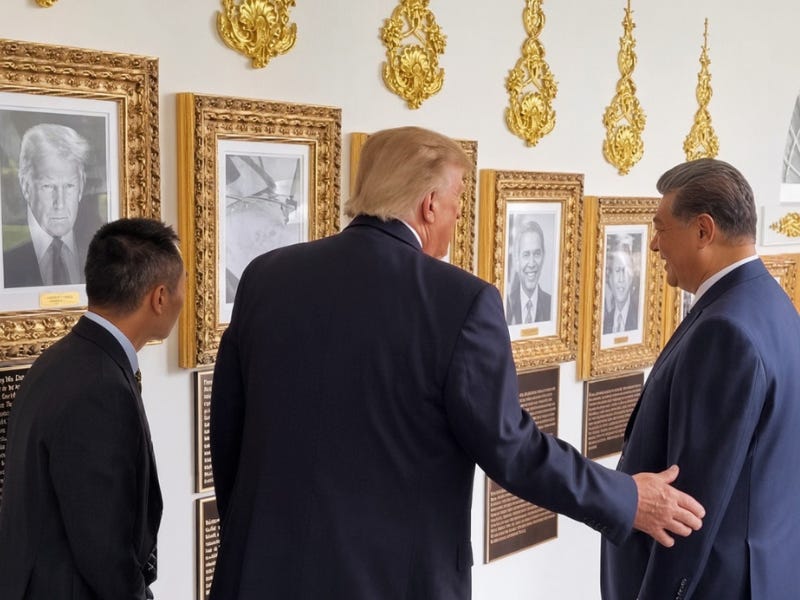
Still, I didn’t have an enormous problem with Trump hosting Xi Jinping at the White House, or even rolling out the red carpet and thirstily greeting him on that airport tarmac (though it broke decades of diplomatic protocol and looked pretty embarrassing). What did make me angry, and offended me as an American, were Trump’s perverse antics with Xi Jinping in front of the Presidential Walk of Fame.
Most of you are probably familiar with the “Presidential Walk of Fame” by now. It was one of the early vanity projects of Trump’s second term: a gallery of gold-framed presidential portraits Trump had installed along the West Colonnade of the White House. Contrary to its name, and its view from a distance, the wall is hardly a tribute to our nation’s leaders. It’s instead a running gag for Trump’s personal amusement and self-affirmation. The plaques beneath the portraits include Trump’s personal sentiments toward a number of presidents.
President Obama is described as "one of the most divisive political figures in American History.” President Reagan is falsely depicted a “a fan of President Donald J. Trump.” President Clinton’s plaque includes mention of Trump defeating his wife in 2016. Naturally, President Trump’s own plaques are overflowing with fawning praise of himself. And President Biden? Well, he didn’t even warrant a portrait. Instead, there’s a picture of an autopen above some obligatory “stolen election” nonsense and a slew of other demeaning remarks.
It’s all very stupid and undignified, of course, but there’s a fine line between something being “stupid and undignified” and profoundly un-American. Trump crossed that line when he paused, in front of the cameras, to make a big show out of the “autopen portrait” for Xi Jinping. The two shared a hearty laugh over Biden’s disparagement, which a White House staffer proudly posted on social media (along with a laughter emoji) to commemorate the national disgrace.
And make no mistake about it: it was a national disgrace — a duly elected U.S. president publicly mocking a duly elected U.S. president in front of (and to suck up to) the communist leader of China. And not only did he do it on American soil; he did it at the People’s House.
The butt of the joke wasn’t Joe Biden. It was America.
Like millions of Americans, I thought Biden was a terrible president. I’ve leveled all kinds of criticism at the man. But none of it matters in the context of an enemy (or at least an adversary) of the United States.
Conservative commentator Jonah Goldberg said it well:
The president of the United States is supposed to be a steward of the executive branch, and when conducting foreign affairs, a steward of America. He has an institutional role, which is supposed to have some continuity from president to president — some institutional respect.
We on the political right used to understand this. It’s why so many of us took exception to President Obama’s “apology tour,” and his inclination to blame so many of his political woes on his predecessor (a practice that has only become more popular since then).
Likewise, we understood, as we did with Hugo Chávez, that a foreign adversary insulting our president, especially within our borders, was an insult to our nation.
I still believe that. If you do as well, you should find it abhorrent that a U.S. president would hand-deliver such an insult to a foreign adversary at the White House. If you don’t, I’d love to hear your reasoning.
Very well written and thoughtful.
This is the sort of history/education that needs the widest exposure.
Thank you.