


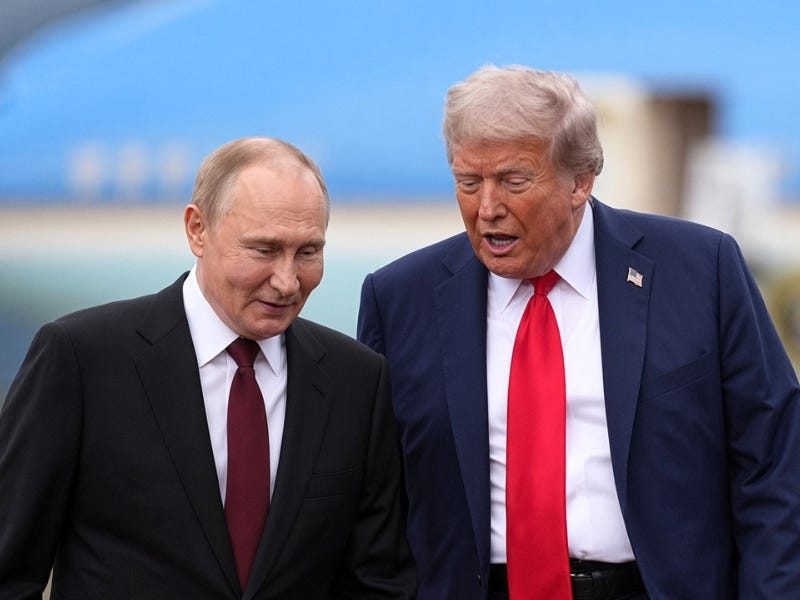
During the last administration, I was critical of what I believed to be President Biden’s inadequate support of Ukraine. Yes, the United States remained a pretty reliable ally throughout his tenure, and Biden spoke out strongly against Putin’s illegal invasion, but our president was often a day late and a dollar short when it came to providing Ukraine with the necessary resources to defend itself. I also worried, in the run-up to the 2024 election, that the same would be true if Kamala Harris became president.
But that worry paled in comparison to what I feared might happen to Ukraine if Donald Trump returned to the Oval Office.
About a month before the election, I wrote:
A Trump/Vance administration should very much concern those who believe it’s vitally important that Putin’s war-crime-ridden invasion of Ukraine ultimately ends in defeat. Trump’s well-documented man-crush on the Russian president, his history of playing games with Ukraine defense-funding (and accusing them of U.S. election interference), and his invitation to Putin to attack our Nato allies are far from the only suggestions that Trump will abandon our ally.
Trump couldn’t even bring himself to say at last month’s presidential debate that it would be good if Ukraine won. Last week, he parroted Russian talking points, declaring that “Ukraine is gone. It’s not Ukraine anymore,” and that “any deal, even the worst deal, would be better than what we have right now.”
I truly hoped that my concerns back then were overstated, and would ultimately prove unwarranted. But as it turns out, I was probably being too generous to Trump.
Our president’s lies about Ukraine and their president, Volodymyr Zelensky, haven’t stopped. They’ve only intensified, as has Trump’s regurgitation of Russian propaganda. Direct U.S. aid to Ukraine has been significantly reduced, and the deadly “games” the administration has played with our remaining aid have not only reached new levels of perversity, but are now being coupled with substantive support for Ukraine’s war-criminal invader, Russian president Vladimir Putin.
The latest series of betrayals began on October 9, when President Trump announced that the U.S. had agreed to purchase potentially millions of tons of diesel fuel from Russia, in a purported effort to bring down high gas prices in the United States (which Trump has been falsely blaming on Ukraine). Such a deal would mean billions of U.S. dollars sent to Russia — dollars that would assuredly be used to fund the Russian war machine against Ukraine (while making virtually no difference to what U.S. consumers would pay at the pump).
Two days later, amidst successful Ukrainian strikes on Russia’s oil industry, Trump announced that he had successfully negotiated an “energy cease-fire” between Russia and Ukraine. The announcement came as a huge surprise to pretty much everyone… including Russia and Ukraine, who hadn’t a clue what Trump was talking about. Still, Zelensky complied with the terms by pausing Ukraine’s strikes on Russian oil targets. Russia, however, continued targeting Ukrainian energy sites, nullifying the “agreement” that Trump later acknowledged he had basically made up (presumably because he worried Ukraine’s strikes on Russia would screw up his diesel deal).
Early last week, about 24 hours after Trump’s “cease-fire” announcement, Ukraine officials reported that they were no longer receiving their usual U.S. intelligence warnings of incoming Russian ballistic missiles, including those targeting Kyiv. Soon after, Ukraine reported connection slowdowns of the U.S.-provided Starshield internet-satellite system, which the country uses to guide their military drones.
While Ukraine was left to deal with the increasingly chaotic situation, Trump announced on Friday night that he had signed an executive order exempting Russia from the crippling sanctions recently passed by Congress in the Lindsey Graham Act.
The hugely generous favor to Putin was met with bipartisan criticism, including from Trump’s former vice president, Mike Pence.
“President Trump’s decision to waive sanctions against Russia as Putin continues his brutal war of aggression against Ukraine dishonors the legacy of the late Senator Lindsey Graham and is decidedly not in the national interests of the United States and should be reversed,” said Pence. “Putin is a war criminal and only understands strength. Waiving Graham Act sanctions on Russia signals weakness at a moment that demands American strength.”
On Sunday, President Zelensky said that U.S. intelligence sharing had resumed, but that their Starshield access had been capped and is still severely limited.
Elon Musk, CEO of Starshield’s creator, SpaceX, is insistent that the U.S. government — not his company — is behind it. Trump has denied the claim, while continuing to blame Ukraine for the war, calling for Ukraine to elect a new president, and arguing that Ukraine, not Russia, has been the obstacle to peace.
Zelensky agrees with Musk, saying on Sunday that Starshield’s manipulation is “a message from the American government.” Zelensky also revealed that the U.S. is holding back on providing Ukraine with already-paid-for Patriot interceptors, which are used to stop incoming Russian ballistic missiles.
Trump, it seems, is firmly holding onto his previously stated belief that “any deal, even the worst deal,” is better than continued fighting between the countries. And the withholding of U.S. intelligence, Starshield access, and other defensive resources all further add to the conclusion that Trump prefers a “deal” that amounts to Ukrainian surrender… even as Russia, the invading country that targets innocent civilians every day (and is aiding the Iranian regime against us), has been dramatically weakened.
As The Dispatch reports:
On the battlefield, this year has been one of Ukraine’s strongest since 2022: Russia’s advance has slowed sharply, in April its forces lost more ground than they took for the first time since August 2024, and Ukraine’s long-range drones hit a Russian oil refinery about once every three days in the first eight months of 2026. And after nearly two years of Russian forces slowly grinding forward in the Donetsk oblast, as of October 14, Ukraine had regained 107 square miles of territory and significantly reduced Russia’s summer push to encircle Ukraine’s remaining cities in the Donbas.
That success has been largely due to Ukraine’s drone superiority and skill—enabled in large part by Starshield, the military-grade version of SpaceX’s Starlink satellite internet network, which many Ukrainian drone operations depend on.
Vladimir Putin has assuredly concluded that he can’t win his war on Ukraine on the battlefield — not with how strong, innovative, and resilient of a foe Ukraine has proven itself to be. He’s been at it for over four and a half years, and his country continues to incur terrible costs as a result of his unprovoked aggression.
That a president of the United States would step in at this moment, and try to save Putin by knee-capping Ukraine, is beyond disgraceful. It’s a stain on our country, and those inclined to defend or rationalize this betrayal wouldn’t dream of doing so for Biden, Harris, or virtually anyone else.
President Trump is trying to keep those cost down
John, you say doing nothing is good for the country concerning diesel?