


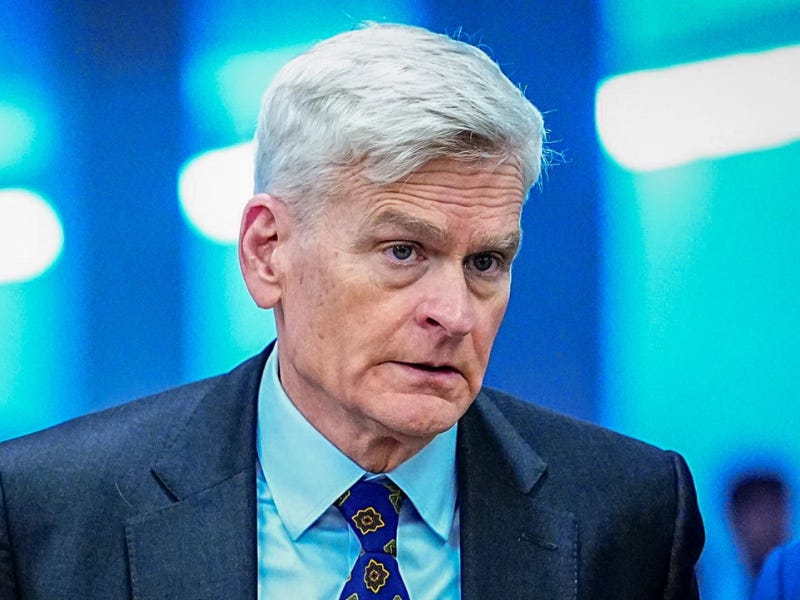
Over the weekend, Senator Bill Cassidy (R-LA) found himself in the familiar position of being the deciding vote on a highly controversial Trump cabinet nominee. This time it was Todd Blanche. Blanche served as acting Attorney General for just a few months, but quickly demonstrated his commitment to further politicizing the Justice Department during that time. Highlights include him trying to establish the transparently corrupt $1.8 billion taxpayer-funded “Anti-Weaponization Fund,” exempting President Trump from IRS audits, and criminally indicting former FBI Director James Comney over his placement of seashells on a beach.
Cassidy made his intentions clear on the Senate floor a day earlier. After stating his deep concerns with the nominee, the senator, reading closely from his notes, listed what he viewed as Blanche’s strengths and achievements.
Then… things got strange.
Cassidy argued that because Blanche previously served as Trump’s personal attorney, he would be “precisely the person to push back on” the president. He added, “The choice is not between perfection and Mr. Blanche. It is between Mr. Blanche and another acting attorney general who may not run the department effectively under President Trump and who indeed may not be as good as Mr. Blanche.”
‘It could be worse’ doesn’t feel like a particularly compelling argument for selecting a top cabinet official, but it was the one Cassidy offered. The senator then soberly declared that he would vote to confirm Blanche, adding, “I’ll be criticized for this vote. What’s new?”
At that point, Cassidy was overcome with emotion, appearing to tear up as he struggled through the last sentence of his prepared remarks: “But the people of Louisiana can be assured that I worked hard to understand the issue and to make the right decision.”
It’s hard to look at that clip and see anything other than a defeated man — a once widely respected elected-leader, tormented by his conscience in the face of a consequential decision for the country, surrendering — again — to political pressure.
And just like that, the last four months of brazen corruption and attempted corruption from Blanche (and the DOJ under his direction) was effectively ratified by the U.S. Senate.
One can only imagine what’s next on Blanche’s docket, now that he has the wind at his back.
The tale of Bill Cassidy is a tragic one. He did the right thing after January 6, 2021 when he voted to convict Donald Trump for inciting the attack on our nation’s Capitol. It likely wasn’t an easy decision at the time. Trump, after all, was the popular leader of Cassidy’s party, and just weeks after the attack, polls made it clear that the Republican base was rallying around the former president.
Cassidy could have just gone along to get along, and let Trump off the hook. That’s what most GOP leaders did. Instead, he patriotically put the country and U.S. Constitution above politics.
The senator did have one political advantage that most of his pro-impeachment colleagues didn’t. He’d won reelection just a few weeks earlier, guaranteeing himself another six-year term. That would give his deep-red Louisiana constituents (and the rest of the country) plenty of time to move on from the Trump years.
But, as we know, Republicans didn’t want to move on. Most never gave up on the lie that Trump had won the 2020 election. Many latched onto related conspiracy theories (including alternative January 6 realities) and never let go, convincing themselves that Trump was not an instigator, but rather a victim, of terrible injustices to our country.
Republican voters decided that Trump was therefore owed another term in office. And in November of 2024, after years of high inflation, a mentally compromised President Biden, and Kamala Harris failing to impress as Biden’s last-minute replacement, enough of the electorate was compelled to agree.
By then, all but a few pro-impeachment Republicans had been purged from Congress, not through general elections, but party pressure and GOP primaries (often with Trump’s direct involvement). Senator Cassidy, like the rest of us, watched it all play out. He planned to run again in 2026, and decided that if he were to stand any chance of being reelected, he’d need to pucker up and give Trump whatever he asked for… including the confirmation of Robert F. Kennedy Jr. as Secretary of Health and Human Services.
Cassidy, a highly-respected physician, understood better than anyone in the senate just how glaringly unfit Kennedy was for the position. The senator openly stated his concerns — passionately at times, including over Kennedy’s long history of nutty vaccine-skepticism and healthy-industry conspiracy theories. But it was ultimately all for show. Cassidy surrendered his better judgment, and served as the deciding vote to put Kennedy in charge of our nation’s public health (along with confirming the rest of Trump’s nominees over those first few months).
Unsurprisingly, Kennedy made Cassidy pay for that decision. Within months, the HHS Secretary reneged on every vaccine-related assurance he’d offered the senator. He also defunded promising mRNA research, of which Cassidy was a vocal proponent.
Still, Cassidy’s reelection hopes remained alive. He spent lots of time publicly flattering the president, supporting him politically, and lobbying for him to be awarded the Nobel Peace Prize. But it was all for nil. Trump urged an election-denying primary opponent into Cassidy’s race, and quickly endorsed her. On the day of the Louisiana primary, Trump took the opportunity to call Cassidy a “disloyal disaster,” a “sleazebag,” and a “terrible guy.”
Cassidy, a two-term incumbent senator who’d won both of his previous statewide elections by double digits, finished in third place with less than 25% of the vote.
Following his defeat, Cassidy threw out some bold, independent talk, suggesting that in his final months in office, he’d stand up to the Trump administration when it made sense to. There was reason to think he might just do it, seemingly having nothing to lose politically. But Blanche’s nomination was a perfect opportunity to showcase that independence, and Cassidy, instead, just caved again.
“Battered wife syndrome all the way down,” a buddy of mine suggested as the reason.
I suppose there could be something to that, especially after Friday’s emotional display (which Cassidy later attributed to the overwhelming honor of being a senator).
“He doesn't want to spend the remainder of his life looking over his shoulder for that deranged MAGA thug who wants to avenge Donald Trump,” another theorized.
I doubt that’s the explanation, being that Cassidy’s impeachment vote (which he says he doesn’t regret) assuredly angered his constituents more than rejecting Blanche ever would have. Still, I suppose Cassidy could be longing for a peaceful Louisiana retirement, and is done ruffling partisan feathers.
Others are suggesting that Cassidy’s thinking about a future job as a lobbyist.
At this point, the “why” doesn’t matter much to me. What may matter to some of my readers is “why” I’m focusing specifically on Cassidy, when dozens of other Republican senators voted to confirm Blanche as well. I heard from people making that point after I singled him out for his RFK Jr. vote, and I suppose their question is a fair one.
The reason is that Cassidy, with his impeachment vote, proved he has more integrity, and a higher regard for the U.S. Constitution, than nearly all of his Republican colleagues. One could summarize that rationale as “he knows better,” but the truth is that most of the GOP Congress has long known better, but often chooses to do the wrong thing anyway.
Cassidy actually is better (or at least was better), and that’s why I expect more from him.
Maybe that’s unfair to the senator, but after handing the keys to people like Kennedy and Blanche, I guess I don’t care.
The only explanations I can think of are a) wanting a peaceful retirement in LA, and leaving office giving Trump the middle finger may have complicated that, b) he still has some career aspirations, either directly or indirectly tied to politics, and basically didn't want to ruffle any feathers. Perhaps he's looking at a state level job in LA. Who knows?
Many are elected but few seem able to sustain this sage advice:
"This above all: to thine own self be true,
And it must follow, as the night the day,
Thou canst not then be false to any man."
Cassidy will soon be just another figure soon forgotten. The captain of his own rudderless boat.