


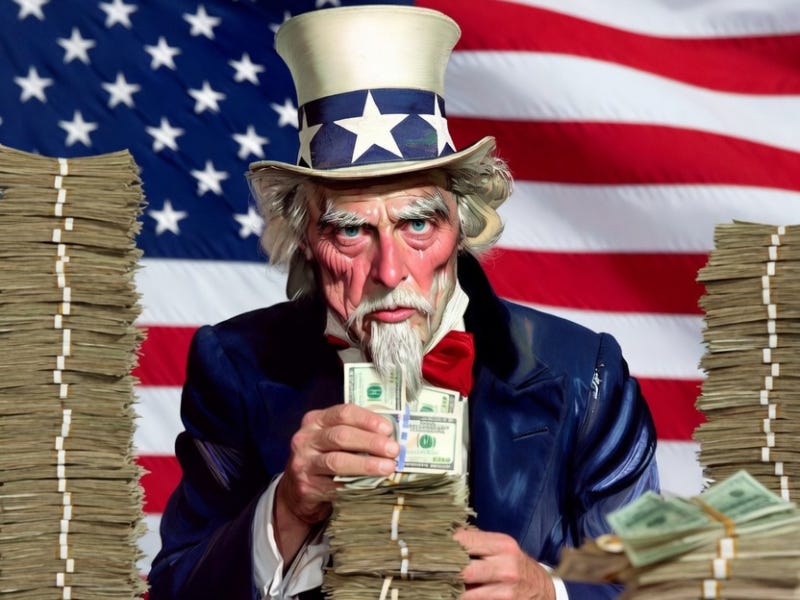
Back in February, the Supreme Court ruled that President Trump’s nearly year-long “emergency” tariffs were, in fact, unconstitutional. The ruling didn’t come as a surprise to many legal experts and constitutional scholars, who long recognized that the International Emergency Economic Powers Act was being abused. There was, however, a good amount of speculation over how the approximately $166 billion (plus interest) illegally collected from the tariffs would be refunded to the American companies who paid them… or if that would even happen.
As the New York Times recently reported, we’re beginning to get answers on that:
By Monday morning, those companies could begin submitting documentation to the government to recover what they paid in illegal tariffs. In a sign of the expected demand, more than 3,000 businesses, including FedEx and Costco, had already sued the Trump administration in a bid to secure their refunds before the application website launched, with some cases filed even predating the Supreme Court’s ruling.
But only the entities that officially paid the tariffs are eligible to recover that money. That means that the fuller universe of people affected by Mr. Trump’s policies — including millions of Americans who paid higher prices for the products they bought — are not able to apply for direct relief.
Assuming this all goes through (it’s possible the administration could put up roadblocks), it shouldn’t surprise anyone that the federal government won’t be paying consumers a dime back of the artificially high, tariff-induced price-hikes they’ve had to endure over the last year. It was U.S. importers, not other countries (as the president has long contended), who directly paid the tariffs — aka taxes. So, any attempts by consumers to get reimbursed would have to go through a distribution chain of companies, perhaps in the form of class action lawsuit (that likely wouldn’t get far). Some companies may feel charitable enough to pass some of their federal repayment down to customers, but that’s entirely up to each company.
In the overwhelming majority of cases, consumers will just need to live with their losses.
To make matters worse, the $166 billion collected from the tariffs (the largest tax hike in over 30 years) has already been spent on other federal initiatives. That means the reimbursement amount, plus hundreds of millions of dollars more in interest, will be added directly to our national debt (which is currently racing toward $40 trillion).
In the meantime, while the aftereffects of these tariffs continue to work their way through the global economy (along with Trump’s ongoing non-emergency tariffs and continued efforts to impose new tariffs under different statutes), it’s becoming clearer and clearer just how damaging this entire, unilaterally-imposed experiment has been.
Free-trade conservatives and economists had long predicted the turmoil caused by Trump’s tariffs (lessened only by the president pulling back on some of his most crippling ones), and U.S. manufactures (who were supposed to be their biggest beneficiaries) — have long opposed them. But Trump thought (and still believes) that tariffs are cool, so we got a whole bunch of them.
At least the president got some ego-gratification and flashy gifts out of it. The rest of our country mostly came away with unnecessary burdens and hardship.
“In the history of the worst self-inflicted policy debacles, the administration’s tariff policies should be on the short list,” remarked Kim Holmes, former Assistant Secretary of State, and former Executive Vice President at The Heritage Foundation.
Holmes elaborated:
They were wasteful of government time and money.
They harmed the economy and US companies and did nothing to restore US manufacturing.
They fleeced consumers who will not get the money back that was paid in higher prices.
Since the administration is now reimbursing US companies, it’s admitting by its actions (if not its words) that that the tariff critics were right all along and that Trump was obviously wrong. That is the very definition of failure.
They set a terrible legal precedent that thankfully the Supreme Court corrected, but which along with other instances of bending the law, generally undermine the rule of law.
Any other money collected from tariffs that still remain in the US Treasury were still taken out of the US private economy and thus is still not available for investment, hiring new employees, paying wages and other things that American companies need to do.
They represented a blatant abdication of Congress’s constitutional role in our system of government.
And that doesn’t even include all of the trade relationships the U.S. has needlessly strained or destroyed by waging this trade war, in addition to finding other ways to drive away allies.
Now, there is actually a silver lining in all of this (as long as the administration holds true to its reimbursement plan). Injecting over $166 billion back into the U.S. private sector, to its rightful owners, will amount to some good economic stimulus. Affected companies that have long been holding off on reinvesting, bringing on new employees, and increasing salaries, will suddenly be in a better position to do those things.
It would seem a no-brainer, then, that every company that paid Trump’s illegal tariffs would apply to get reimbursed. That, however, is not certain. President Trump has already stated that he’ll “remember” the companies who choose not to apply for a refund, suggesting that he may give them some type of preferential treatment in the future. A different read is that he’ll find a way to punish those who do apply. Either way, it’s a wildly inappropriate gesture, and I suspect the overwhelming majority of these companies are done playing Trump’s games.
Regardless, prices should go down on a number of items, and some of our trade relationships should start to normalize (unfortunately, others may be irreparable). Even with our continuing challenges (including the high cost of oil, and Trump’s other tariffs), the added means and certainty will assuredly have a positive economic effect on our country.
It’s just a shame that the U.S. Congress let the administration go down this very painful path for almost a year before the judiciary — our last functional branch of the federal government — finally addressed the situation.
Well written and all true, Americans paid more for nearly everything and in some cases still are, but won't get any compensation for this monumentally hare-brained idea.
Remember "Liberation Day"? The only thing that was liberated was money from from your wallet.
The entire tariff debacle was DUMB from the start! Which of his toadies told him most a good idea? Those individuals should be fired.