


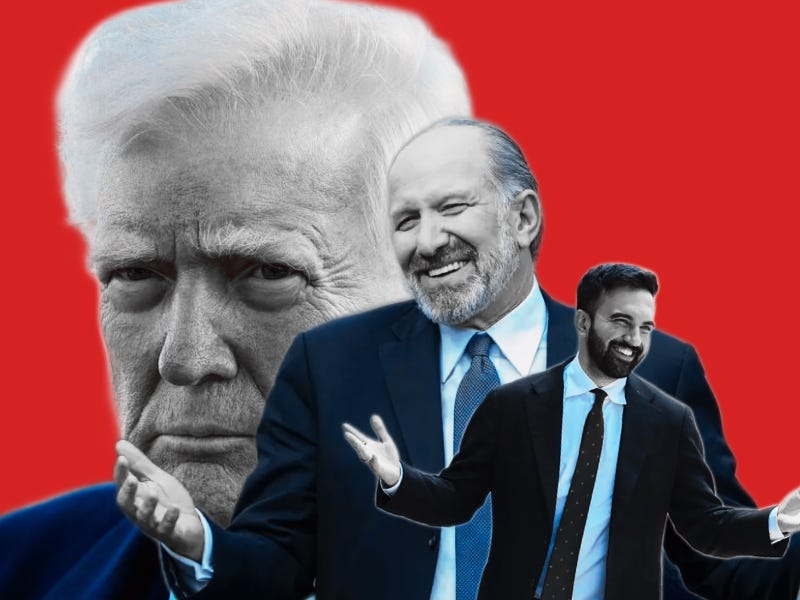
In a recent Washington Post piece, conservative columnist Jim Geraghty guided readers through what I think was a very useful political exercise. He compared the rhetoric of New York mayoral candidate (and self-avowed socialist), Zohran Mamdani, with the actions of our president (and leader of the Republican Party), Donald J. Trump.
He quoted from a 2021 speech, in which Mamdani talked to fellow socialists about “the end goal of seizing the means of production,” then pointed to Trump’s negotiation of a “golden shareholder” government-stake in U.S. Steel, a 15 percent stake in the rare earth minerals mining company, MP Materials (purchased with $400 million in taxpayer dollars), and a 10 percent stake in the chip-making company, Intel.
“Instead of having the government take greater control of private companies the way Mamdani wants,” Geraghty writes, “the administration is having the government take greater control of private companies the way Trump wants.”
Philosophically, there isn’t much of a difference between the two. Mamdani wants to control the means of production, while Trump wants a controlling interest (as the largest shareholder) in the means of production. The larger disparity is in execution. Mamdani, so far, has been all talk. Trump, on the other hand, has actually done it (and is promising other such “deals”).
Notably, the president has received very little push-back on these moves from fellow Republicans, including those who’ve been sounding the alarm for months on Mamdani’s socialist agenda. This shouldn’t surprise anyone, of course, but it does raise another point…
For about a decade now, Trump’s defenders have argued that he should be judged not by his words, but by his deeds. I’ve long rejected that notion for a couple reasons: 1) a president’s words have real consequences, and 2) those making the argument never extend the same courtesy to other political leaders.
Case in point, what Trump has been doing (not merely saying) is closer to textbook socialism than anything Mamdani (or even Joe Biden for that matter) has done in practice. And since Trump’s loyalists are largely fine with his moves, and in some cases downright enthusiastic about the “deal-making” prowess that has brought them to fruition, it would seem that they’re far less worried about socialism than who’s pulling the socialist trigger.
As Geraghty’s headline reads, “When Mamdani says it, it’s socialism. When Trump does it, it’s genius.”
Next, consider that this is just one of several issues in recent years, in which we’ve seen principled ideology inverted for the sake of political reverence to Donald Trump.
I mean, ten years ago, who would have predicted that Republican leaders (and much of the Republican base) would turn on free trade, and fall in line with the trade-policy ideas of Bernie Sanders? Who’d have thought Republicans would be cheering on the largest tax increase in U.S. history (an average of $1,300 per U.S. household), and framing it as an “investment in the USA” (a Democratic talking-point)? Who would have thought that the GOP would abandon all serious efforts to address the national debt, and watch on with indifference as a Republican president, in just four and a half years, signed into law $13 trillion in debt?
Again, these are deeds, not words. But as someone who’s consistent in their view that words do matter, I’ll also point out that Commerce Secretary Howard Lutnick has been talking about nationalizing defense contractors like Lockheed Martin. This would be another big lurch toward full blown socialism… which would assuredly receive the same party-pass as the previous lurches.
The unfortunate reality is that true socialists — those driven by ideology rather than party interests — would absolutely like much of what Zohran Mamdan has been saying. That’s a problem. They would also like much of what Donald Trump has been doing. I’d argue that’s a bigger problem.
It’s interesting… Many on the New Right like to chide conservatives like me by asking us the question: “What did the conservative movement ever conserve?”
Well, as it turns out, it was conserving quite a bit — including free trade, affordable goods, and non-nationalized enterprise. It also spared us from the indignity of adopting socialist doctrine in the name of defeating socialists.
You don't get it, John - we're going to own the libs, by adopting their economic policies and social grievance culture, and then drink their tears.
I see your point John and well made. But this isn't the first time in history that the federal government has been involved in funding companies. I'm thinking Amtrak, GM, and Chrysler, as well as nationalizing railroads and other industries during war. Almost all are temporary. Trumps point of view is in place of subsidies, loans, etc., to take a stake in these companies. If this is a long-term strategy, this policy is dangerous and certainly goes against conservative values. But those values may need adjustment.
The threat of the Chinese government that invests heavily in strategic areas such as rare earth minerals and battery production is real and they control the world market. Some funding, investing, or whatever we want to call it is necessary when it comes to strategic materials as well as AI and chip manufacturing. We are way "WAY" behind the curve, and this must change. Some investments are too large to expect the private market to fund and I believe this would have been a major problem for PM Materials. We can't fail in these three markets, and the future of our country depends upon it.
We've done this in the past, whether right or wrong, but this is a far cry from the type of socialism where Mamdani wants to control the means of production.
I don't agree with the government investing into companies on a whim. But I see the strategic necessity in some industries to compete with China and their doctrine to control the world.