


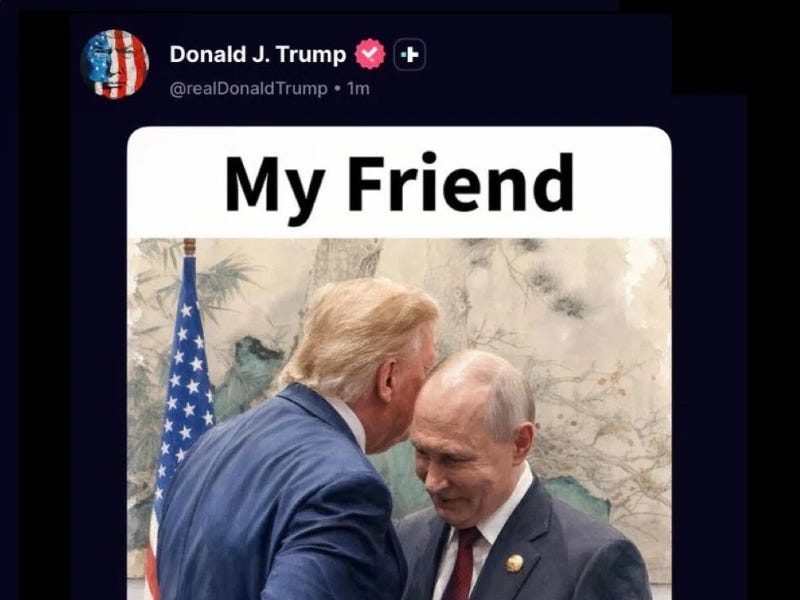
Last Saturday afternoon on Truth Social, President Trump proudly posted pictures from his recent trip to Shenzhen, China, for the APEC summit. One of the photos was an almost angelic-looking image of himself whispering sweet nothings into the ear of Russian president, Vladimir Putin. Above the image was the large caption, “My Friend.”
It effectively memeified the leaders’ in-person meeting, a couple days earlier in front of cameras, when Trump gleefully pointed at Putin and said, “Who is he? He’s my friend!”
“Genuinely, have you ever seen [Trump] this happy to see anybody?” journalist Andrew Egger remarked at the time.
Frankly, I don’t think I have.
Regardless, the gesture received heavy scrutiny back in the states, from both lefties and righties. Words like “disgraceful,” “shameful,” “embarrassing,” and even “insane” were used to describe Trump’s latest coddling of Putin, his war-criminal crush. Similar takes were shared hours prior the president’s post, when Trump publicly blamed America for Russia’s invasion of Ukraine, discouraged European leaders from continuing to aid Ukraine, and told Putin he’d help protect him from International Criminal Court — all while Putin was actively murdering small children and bombing hospitals in Ukraine.
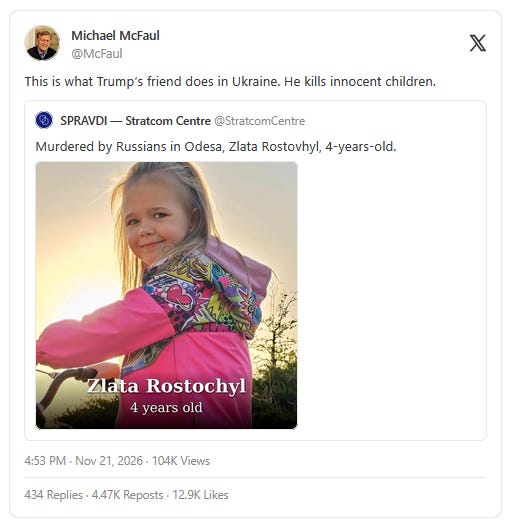
According to the latest numbers, close to 800 Ukrainian children have been killed since the start of Putin’s illegal invasion, and over 20,000 have been kidnapped by the Russian military and relocated to Russia. The overall death toll from the invasion is in the hundreds of thousands, and at least 20,000 of those people were Ukrainian civilians.
That’s quite a legacy Trump’s “friend” is building for himself.
For over a decade, political observers have tried to understand Trump’s infatuation with Putin, and his desperate need to be liked and respected by such an evil man — a sworn enemy of the United States who’s lately been helping the Iranian regime target U.S. troops. People have wondered how our president could possibly take Putin’s word over the findings of U.S. intelligence agencies on the matter of election interference, regularly draw moral equivalency between Russia and the United States, invite Putin to attack our Nato allies, and play games with Ukraine’s defenses, cut off their U.S. funding, and even attempt to fund Putin’s war-machine against them.
But for me, this has long been a rhetorical question. The answer has been obvious for quite a while. Trump likes strongmen. He admires that Putin rules with an iron fist. He likes that Putin strikes fear in his opponents, punishes them at his leisure, and takes what he wants. In many ways, I think Trump wishes he could be more like Putin. That’s why he so aggressively seeks Putin’s approval, wants to be photographed with him, and longs to pursue business interests with him.
Frankly, I think most people already know this, including some of Trump’s biggest defenders. Sure, they’d prefer not to say it out loud, because they recognize how warped it is. They instead argue (at least in public) that there’s some kind of three-dimensional chess strategy behind all of this — not for Trump’s personal benefit, but rather for the benefit the United States and the rest of the free world. They repeat phrases like “he moves the needle” and “he brings Putin to the table.” They absurdly label Trump’s capitulations as “peace through strength.” They even defend him with the cinematic line, “Keep your friends close, but your enemies closer.”
But that’s clearly not what Trump is doing. The president has spent his entire second term alienating America’s friends. He’s needlessly damaged longtime, mutually beneficial alliances and partnerships, while making the lives of some of America’s worst enemies and opponents easier. As with the trade war, his mass pardons, and his political weaponization of the DOJ, strengthening Putin and weakening Ukraine is not in America’s interests. It’s in Trump’s personal interest. Pleasing his “friend” warms his heart, and so that’s what he does.
How much more evidence of this is needed? And who all genuinely remains unconvinced?
I had plenty of criticism for President Biden’s handling of Ukraine. He was often a day late and a dollar short in his support of our ally, I think largely because he worried too much about escalation. But he was a supporter nonetheless, as America should be (and would be, if almost anyone other than Trump were in office).
I think Trump has made clear through his actions that he wants Russia to win. I think he believes a Russian victory would not only solidify the relationship he’s always wanted with Putin, but also earn him a Nobel Peace Prize for delivering an end to the fighting through Ukraine’s effective surrender.
He seems to recognize, however, that he can’t directly ally with Russia without there being extraordinarily negative consequences that would go well beyond the current conflict, and possibly even get him ejected from office. What he can do (and has done) is put his thumb on the scale in Russia’s favor. And Ukrainians have paid a terrible price for that betrayal.
People are certainly free to pretend there’s hidden virtue in all of this, and that Trump’s treatment of Putin will ultimately benefit — and reflect well on — America. But I think we’ve already reached the point that such people aren’t even fooling themselves.
As much as I would like to say Trump is playing a brilliant poker hand, I cannot. I understood the not to long ago red carpet treatment Putin was given as a last ditch effort to get some agreement but Putin went right back to doing what he does. That should have been enough for Trump to say 'I tried' and then ramp up support to Ukraine. I do disagree with you on Biden since we all know he did absolutely nothing on his own, positive or negative, as he was simply a spokesperson for the progressive left, much like all those Democrats who took over Congress. Trump never learns. May 2028 bring us moderation
Add Bill O'Reilly to the list of Trump's defenders using the "keep your friends close, and your enemies closer" line in his column published just yesterday. O'Reilly's argument is that no one else has offered a better solution, correctly pointing out that we don't want to launch a devastating all out war with Russia. But there is a big difference between dialog and diplomacy and abject capitulation and humiliation. Trump's reaction when he saw Putin at the meeting reminded me of a toddler being dropped off at daycare, and seeing his BFF. Absolutely pathetic.