


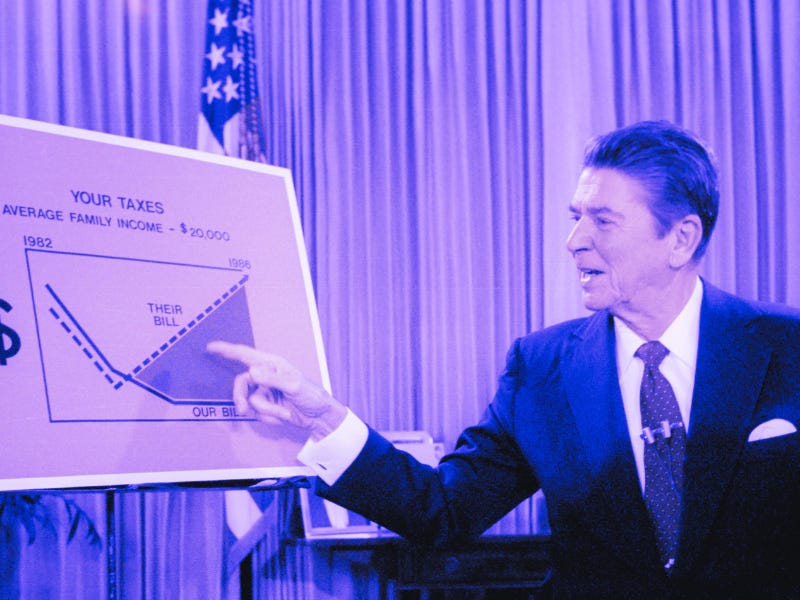
Last week, I co-interviewed Reason magazine’s Stephanie Slade about her new book, Fusionism: Liberty, Virtue, and the Future of the American Right. For those unfamiliar with the term fusionism in the context of American politics, it refers to a conservative philosophical synthesis that combines traditionalist/social conservatism (which emphasizes virtue, moral order, and inherited traditions) with classical liberal or right-libertarian principles (which emphasize individual liberty, free markets, and limited government).
This philosophy is perhaps most commonly associated with Ronald Reagan and Reaganism, which defined the Republican Party in the 1980s. Its origins, however, go back decades earlier to Frank Meyer, William F. Buckley, and National Review magazine in the 1950s.
Unfortunately, one would be hard-pressed to now find anything more than remnants of fusionism on the American Right. Today’s GOP largely defines itself by personal allegiance to President Trump (and whatever he decides to do or say on any given day).
Historically speaking, however, Slade argues that fusionism’s decline began decades before Trump arrived on the political scene.
“I think Reagan was sort of the apotheosis moment,” Slade told me. “… In America, the conservatives are trying to conserve the principles and institutions of the American founding… And that meant a commitment within the conservative movement to this sort of classical liberalism — the separation of powers, the rule of law, limited government, free markets.”
Slade explained that Reagan’s espousal of these principles, and his landslide electoral victories, pulled the GOP into alignment with fusionism. However, after the end of the Cold War, she argues, there was a decline of interest in talking about and promoting fusionistic principles, along with liberty and virtue.
“That kind of all goes away,” said Slade, “and you end up with a Republican Party and a conservative movement that is really mostly focused on just acquiring political power, winning elections, getting our guys into office, and beating the left.”
Slade called it an “understandable mistake,” adding, “There was this sense after Reagan and after the fall of the Soviet Union that ‘Our ideas have been so clearly vindicated that surely we don’t have to spend all this time thinking and talking and debating and persuading of that. Who could possibly doubt this liberty/virtue synthesis is the recipe for a successful society?’ But it turns out over time that if you don’t do the hard work of tending to that philosophical foundation, it will erode.”
I think Slade is largely right, though I also think she’s being a little hard on the post-Reagan, pre-Trump conservative movement. After all, I was only 16 years old when Reagan left office, and I couldn’t have told anyone at that time, other than in very abstract terms, what principles Reagan stood for. That wasn’t Reagan’s fault, of course; he was a brilliant communicator. I just couldn’t have cared less about politics in my youth, and took many things (including American prosperity) for granted.
Like many kids in the 1980s, I was raised with generally conservative sensibilities, but my political conversion to Reagan conservatism (or fusionism, if you will) didn’t really take shape until I was close to the age of 30. It came with the help of Republican and conservative thought leaders of the post-Clinton era — the types of people who used to be welcome on Fox News. I found their ideas, passed on from decades earlier, persuasive and aligned with historical success.
In other words, the torch was still being carried… at least at that time.
That said, if I hadn’t become a news junkie after 9/11, I may have never opened myself up to the conservative principles and voices that ultimately resonated with me on an intellectual level. As the president of the United States, Reagan spoke to the entire country from their living room (though a small number of widely watched television networks), and sold a large majority of Americans on his vision. Conversely, a dozen years after he left office, I had to go looking for well-articulated conservative wisdom. Thankfully, I found it.
Regardless, what was left of Reagan conservatism by 2016 took a sharp nosedive with the election of Donald Trump. Though two-thirds of Republican voters wanted a different presidential nominee that year, enough ended up supporting Trump in the general election to get him across the finish line. At which point, Republican and conservative advocates of things like moral character and decency, inherited traditions (including our constitutional order), limited government, free trade, and the rule of law found themselves increasingly at odds with the party that used to defend all of the above.
Over the years that followed, if Reaganites didn’t surrender their principles and positions for Trump, and play the role of his unconditional defender, they were considered turncoats and pariahs. They were called “liberals” and “progressives,” and purged from their positions of influence, including public office and prominent right-wing media platforms.
We’re now a decade into the Trump era, and the effects of the American Right’s unwillingness to stand up for fusionistic principles — in favor of grievance and personality-fueled populism — are on daily display.
Yes, daily. And if you don’t believe me, just look at some things that happened over the weekend…
Capitulation to North Korea
President Trump announced that he ordered Defense Secretary Pete Hegseth to “substantially reduce” the United States’ joint military exercises with longtime ally South Korea, citing his “very good relationship” with North Korea’s dictator, Kim Jong Un. Trump argued that military exercises with South Korea are “totally inappropriate and hostile” to North Korea — who Trump called “unthreatening and respectful.”
The reality, of course, couldn’t be further from the truth. Just days ago, North Korea (who has long run concentration camps the size of Los Angeles, and routinely tortures and executes its own citizens) launched ballistic missiles at our allies, with no stated reason, and then threatened both the United States and South Korea. Pyongyang is actively aiding Russia in its war on Ukraine with missiles, ammunition, and even troops. Kim Jong Un has refused diplomatic talks with Trump and United States, while proceeding with his country’s nuclear weapons program.
It’s crazy that we’ve gone from boldly calling the communist Soviet Union an “evil empire,” and pushing strong policies to precipitate its collapse, to making life easier for perhaps the most brutal dictator on the planet, just because he found a way to personally charm Donald Trump.
But sadly, few on the Right seem to care.
Most Republicans now favor government price controls
54% of Republicans in a new CBS/YouGov poll said they approve of the socialist practice of government price controls. They join 62% of independents and 75% of Democrats.
“We have become economic illiterates,” remarked conservative commentator, Erick Erickson.
The Dispatch’s Stephen Hayes lamented, “Supporters of free markets have a lot of work to do...”
“There is a crisis in economics and history education,” wrote economist Jessica Riedl. “People hear this question and think ‘yes I'd like lower prices’ with no understanding of basic supply and demand, 1970s gas lines, life in central planning systems, etc. Even GOP voters no longer understand how markets work.”
Suffice to say, they “no longer understand” because no one’s reminding them.
In fact, President Trump has done just the opposite, advocating for price controls on prescription drugs and gasoline, and a cap on credit card interest rates — a sharp deviation from the pre-Trump, free-market-friendly, GOP platform.
And few on the Right seem to care.
A closer look at Trump’s billion-dollar ballroom
Thanks in large part to a Washington Post investigation into President Trump’s White House Ballroom expenditures, we now know the price-tag of the massive project: about one billion dollars.
Contrary to the president’s longtime contention that it would be paid for entirely by private donors, U.S. taxpayers are flipping most of the bill — roughly $500 million of it — without Congressional authorization. Those funds were diverted from the White House Military Office and the Secret Service. And since the construction has yet to be completed (due in part to a legal concerns surrounding Trump’s sidestepping of Congress), it’s possible the construction costs will continue to grow.
“Set aside the law for a moment,” responded Gregg Nunziata of the Society of the Rule of Law. “Does it seem right to you that a president should be able to tear down a wing of the White House, build a massive new structure forever changing the executive mansion, while spending a billion dollars of taxpayers funds, just on his own whim?”
The optics of the story have always been bad — a ruling-class vanity project at a time when average Americans have been struggling, for years, with high living costs. But between the violation of the separation of powers, possible illegality, lying to the public about who was flipping the bill, and what some (understandably) consider a desecration of The People's House, this fiasco would seem uniquely symbolic of what conservatives used to refer to as “runaway government.”
And yet… few on today’s Right care.
Now consider, again, that these were just weekend developments — essentially footnotes in the context of the much broader, persistent, foreign and domestic challenges we face as a nation — most of which are being ignored or exasperated at our top levels of government.
It’s neither “TDS” nor “leftist” to care about such things. In fact, it’s just the opposite.
But the problem is even worse than that. Former Reagan conservatives who’ve thrown in the towel — to, in their eyes, remain politically “relevant” or be a team player — are just part of the story. Another big part is the future of the American Right.
“You’ll have generations of young conservatives coming up who have never engaged with these ideas, and don’t really understand the philosophy that they’re supposed to be defending,” Stephanie Slade said during our interview. “They think all that matters is winning elections and owning the left. And that’s kind of how we ended up with the movement we have today.”
It’s a scary thought, and it should be far more concerning to the Right than the viral-video culture battles and tribal loyalties we invest an extraordinary amount of our time and passion in.
Our country would be best served by us actually caring again — caring and informing fellow Americans about big-picture issues that have political solutions… and thankfully blueprints for success.
I think we owe our nation and future generations that.
A wonderful and thought provoking article I have to say, as it makes me daydream a bit of the good 'ole days of just plain old "peace and quiet," feeling secure in our leadership as we lie our heads on the pillow each night... Oh, the good 'ole days.
As much as it may wound our pride and challenge "us" versus "them" , Thomas Sowell laid out what our nations founders knew. Instead of trying to “solve” whatever difficulty, disagreement, injustice, and strife exist try instead finding the trade-offs that provide the best possible acceptable to both sides outcome, understanding that no outcome will be perfect.