


Hi everyone.
Welcome to this week’s Daly Weekly, where I answer whatever questions you throw my way.
Let’s get right to your questions…
John, I support taking it to the Iranian regime as well, and I certainly will not shed any tears over the Supreme Leader’s demise. My concern, however, is what exactly is the administration’s endgame in Iran? Is it regime change? Is it to destroy their nuclear program once and for all? Is it to destroy their ballistic missile systems? Is it to punish them for sponsoring terrorism all over the world for decades? Is it, as Trump suggested in one TS post, because Iran supposedly “interfered in the 2020 and 2024 election against Trump”? As you and Bernie pointed out in the most recent no BS Zone, the president owes the Congress and the American people a much more detailed rationale for why this action was necessary at this time. I do agree with you that there IS a case to be made, but they need to make it. My fear is that Trump was emboldened by the relatively painless operation in Venezuela at the beginning of the year, and decided he can just do the same thing in any country that he feels has offended him. I’m afraid he thinks this is Venezuela 2.0, when more likely, it is Iraq 2.0. — John M.
Hi John. I think many of your concerns are valid. The administration’s messaging has been all over the place, and Trump has made statements over the past few days that would seem to line up with the notion that he indeed believed (or at least hoped) things would go as smoothly as with Venezuela. That said, it seems that the Joint Chiefs of Staff and CENTCOM have a pretty good handle on the situation so far. So does the Israeli government, who understands the stakes and complexities much better than our president. The primary objective, despite Pete Hegseth’s press conference tap-dancing, seems to be to totally degrade or dismantle the current regime, including their leadership, military, and major weapons systems, with the ultimate goal of regime change.
That’s easier said than done, of course, but I think we have a good shot at success, and that would pay dividends to the Middle East and the free world for a long time.
Why is it easier to kill an evil, Hitler clone, Iranian Dictator, than it is to pass the Save Act, that 95% of all Republicans support, 70% of Democrats support, and 85% of all Americans support. — Rob O.
Because Operation Epic Fury has been an executive action (in coordination with Israel), and passing a bill into law requires approval from both branches of Congress and a presidential signature. That’s the simple answer, Rob (though I suspect your question was probably rhetorical).
You are correct. Very sad. Political civil war in the near future? — Robert C.
I guess that’s one way of phrasing it, Robert. Like I said in a recent piece, I think there’s a fight to be had for the future of the Republican Party once Trump has been sidelined.
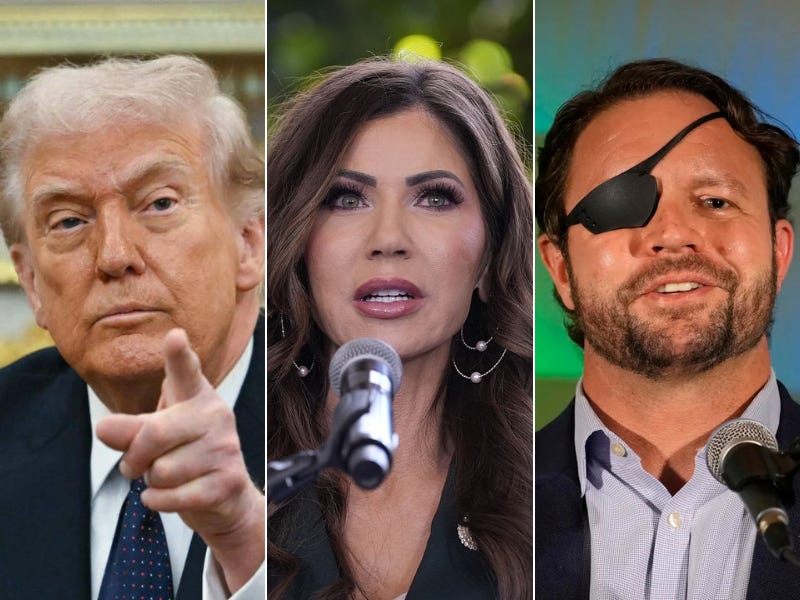
Kristi Noem is finally gone! Are you surprised? — Alex D.
No, but I find it amusing what finally sunk her. It wasn’t her smearing a couple of Americans killed by ICE agents as “domestic terrorists.” It wasn’t her bypassing due-process to send asylum-seekers to a third-world prison. It wasn’t her carrying on an extramarital affair with Corey Lewandowski on the government dime (including a luxury $70 million jet). It wasn’t her awarding, through an irregular process, federal contracts to a company she is closely tied to. It wasn’t her spending over $220 million (again of taxpayers’ money) on a self-aggrandizing ad campaign. What got her in hot water was that she revealed, in a recent Senate hearing, that President Trump had pre-approved that ad-spending. That apparently sent Trump over the edge.
Do you not think there’s ANY future now for Dan Crenshaw in politics? — Ben G.
Oh, maybe in some capacity there is, but I don’t think he could win another GOP primary at this point — not unless the party goes through a major transformation once Trump’s gone.
I do agree that we need both strong Democratic AND Republican conservative party. How to get this done over time? Aloha, Mike
I think party primaries are a big part of the answer, Mike. More voters need to participate in them. Only about 20% of eligible voters currently do, which leaves the increasingly important nomination process up to a relatively small number of people, who tend to have more radical views than the average voter. I’d also like to see ranked-choice primary voting continue to grow in this country.
Thanks everyone! You can send me questions for next week by leaving a comment in the comment section.
John, I admire your optimism about the future of Iran, and once again, I am not shedding any tears for the mullahs or other leaders in Iran that have met their 72 virgins. However, if you look at our track record in the Middle East vis a vis regime chance: Libya, Syria, Iraq, Afghanistan - we are basically 0-4. Our military is the best in the world, and can defeat any other military in the world in conventional combat situations, but "regime change" takes more than that. I just think it's overly naive to think this war won't drag on, in some form for at least 10 years. This looks like Iraq 2.0 to me.
“Why is it easier to kill an evil, Hitler clone, Iranian Dictator, than it is to pass the Save Act, that 95% of all Republicans support, 70% of Democrats support, and 85% of all Americans support. — Rob O.”
Because there's less than 60 ignorant or unethical or spineless people in our Senate.
At best, the Save Act is a solution to a fantasy-driven problem. Study after study has shown that there's hardly any voter impersonation and voting by non-citizens. For example, the 2020 election votes were repeatedly scrutinized. In states where Biden narrowly won, i.e. by 10,000 votes or so, only a handful of votes were fraudulent. If memory serves, none of these votes were for Biden. Even former Atty General Bill Barr, a Trump loyalist, admitted that there was no substantial voter fraud in 2020.
At first glance, the bill is seductive. Even though there‘s hardly any voter impersonation or voting by non-citizens, what’s the harm of requiring a picture ID and proof of citizenship in order to exercise your fundamental right to vote?
As Popeye the Sailor – um, er, uh I mean Ross Perot – emphasized, “The devil’s in the details.”
First, there’s the constitutional issue. Article I, Section 4 of our Constitution states, “The Times, Places and Manner of holding Elections for Senators and Representatives, shall be prescribed in each State by the Legislature thereof; but the Congress may at any time by Law make or alter such Regulations, except as to the Places of chusing [sic] Senators.
"The Congress shall assemble at least once in every Year, and such Meeting shall be on the first Monday in December, unless they shall by Law appoint a different Day.”
The Save Act might be ruled unconstitutional. Assuming the SCOTUS declares it constitutional, its passage would create practical problems.
If passed, millions of otherwise voter eligible Americans would either jump through extra hoops or be denied their right to vote. The tens of millions of otherwise eligible American without U. S. passports or state-issued ID's confirming citizenship would have to bring their birth certificates to prove citizenship.
What if an otherwise voter eligible American shows up at the polls with a copy of his certified birth certificate, one without the original seal. Is that valid? What if an otherwise eligible American shows up to vote but has an expired drivers' license? The Texas voter ID law at least formerly prevented an otherwise voter eligible American from voting unless he had a CURRENT picture ID WITH AN EXPIRATION DATE, i.e. an otherwise eligible American would be denied his right to vote if he is currently a Univ. of Texas student and all he had was his student (picture) ID. Student IDs don't have an expiration date. Of course, if he had a current NRA ID, he could vote because those IDs have an expiration date. But if his NRA ID expired the day before the election, he would be denied his right to vote. That provision might have been stricken by the courts, however.
Does the Save Act have such nonsensical restrictions?
There'd also be thorny problems when otherwise voter eligible Americans' surnames are different from the surnames on their birth certificate, drivers' licenses or state-issued IDs. This problem would predominantly affect women - a lot of women. Of course, women are more likely to vote Democratic. Do these women need to also produce certified copies of their marriage certificates?
The Save Act probably would result in much longer wait times to vote. Current wait times already are frequently too long. If a poll worker allows someone to vote who does not meet the Save Act's strict criteria, he's a criminal. Poll workers advisedly would take their time to meticulously ensure the documents presented are adequate AND authentic – i.e. that they aren’t forgeries. Otherwise, they might be dragged through the criminal justice system.
In addition, beleaguered poll workers would also have to take the time to explain to otherwise voter eligible Americans why they're denied their right to vote.
Can you imagine the abuse and anguish volunteer poll workers or poll workers with paltry compensation would undergo trying to make sure they aren't criminals? Those showing up to vote having "faulty" IDs probably would be livid when the poll worker explains that their ID doesn't conform to the law. The harassment poll workers have been subjected to over recent decades would escalate. Who'd want to be a poll worker if doing so means they'd either be criminals or harassed?
What about the millions of otherwise voter eligible adult Americans who don't have a driver's license, don’t have a state-issued ID and don’t have a copy of their birth certificate? Under the Save Act they would be denied their right to vote unless they go to the trouble and expense of getting their certified birth certificates AND their state-issued IDs or drivers’ licenses. Would that be a constitutionally prohibited toll tax?
The Save Acts also bans mail-in voting, with limited exceptions. In order to be granted an exception, you have to jump through more hoops. Thankfully, now Hawaii almost exclusively has mail-in voting. At first, I was against the idea. But the safeguards and checks are rigorous enough to deter substantial voter fraud. Many eligible voters are single parents working a FT and a PT job. They don't have time to take-off and go vote, especially if there's a long wait time.
Is it constitutional for the feds to ban mail-in voting and to place hurdles in the way of those wanting an exception to this ban?
Those favoring the Save Act either don’t realize its likely ramifications or favor voter suppression. Most in Congress and at least some in the Trump administration certainly are in this latter category. I don’t know what category President Trump falls under.
Some don’t want every eligible American to vote. My experience is that they are usually conservatives. For example, Bill O’Reilly – who is fundamentally conservative despite his denials - said something to the effect that he’s not one who thinks that everyone who can vote should vote. In fairness, Bill Maher – a moderate liberal – also says this.
There's the argument that the Save Act would restore trust in our elections. First, those making that argument strangely look like the ones spreading the lie of rampant voter impersonation or of non-citizens voting. Second, the sour grapes wanting to delegitimize elections that don't go their way typically will find a conspiracy theory to justify their victimhood.