


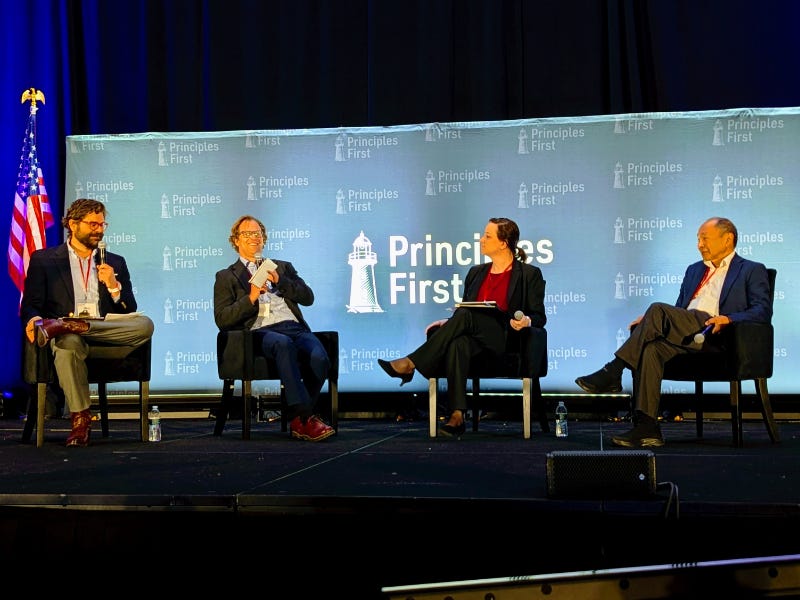
Last weekend, I traveled to Washington DC for the Principles First Summit. It was my third year attending the annual, multi-day event. And as with previous years, I had a great time.
For those unfamiliar with Principles First, it’s a grassroots organization that came together on the political right out of frustration and concern with the direction of the Republican Party under Donald Trump. Founded by lawyer Heath Mayo in 2019, the movement began as a series of regional meet-up sessions around the country. This led to the annual DC event that was created as counter-programming, of sorts, to the increasingly unhinged CPAC (scheduled on the same weekend, and in the same town). The summit features lots of panels and interviews with mostly political, media, and public-policy figures. It also serves as a social gathering for like-minded, regular folks to connect.
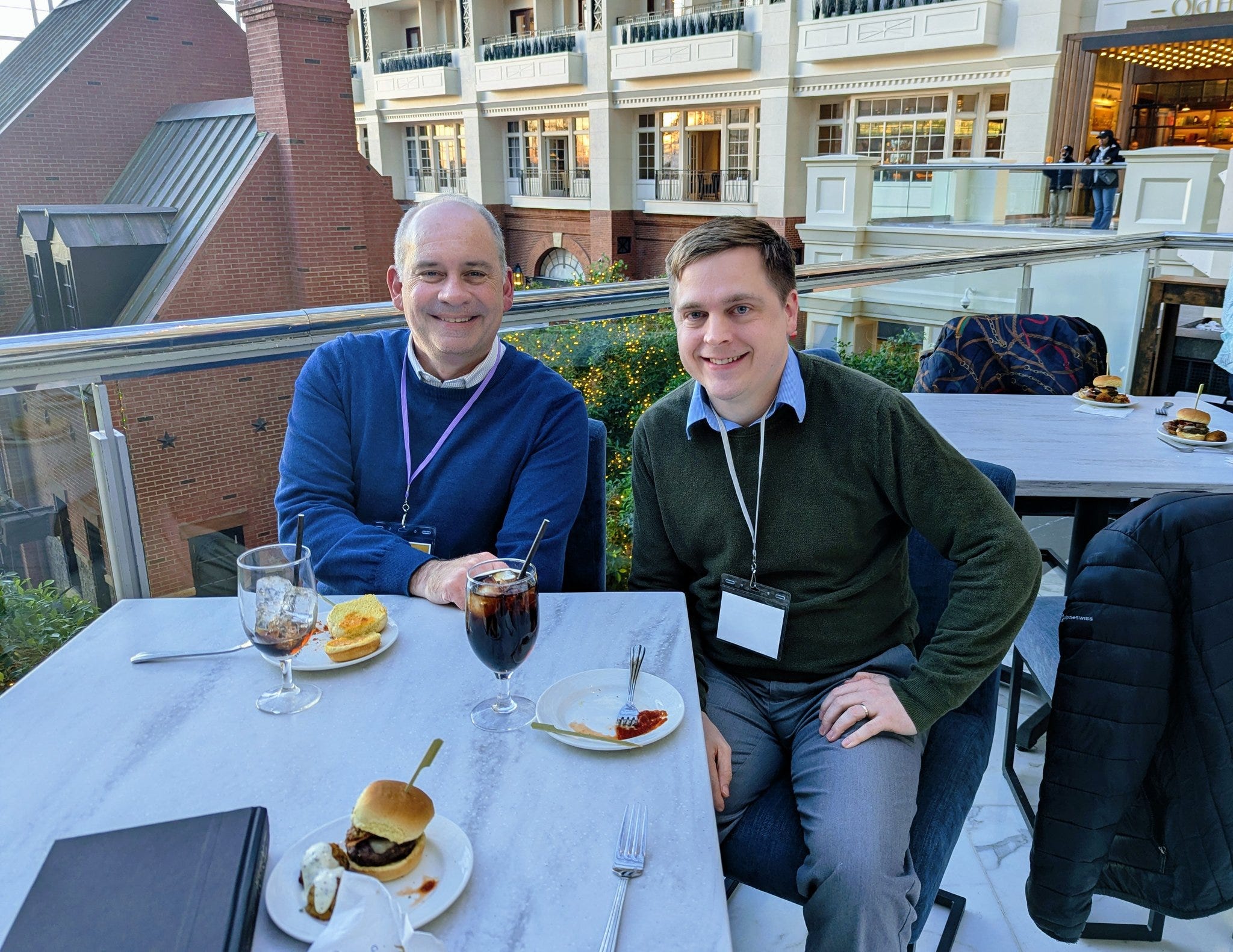
Case in point, I was particularly excited this year to meet (for the first time in person) my Reagan Caucus podcast co-host, Thomas Howes.
Unsurprisingly, hardcore Trumpers have had a special dislike for Principles First from its inception. In fact, last year’s event was disrupted by a group of Proud Boys, including Enrique Tarrio — a convicted January 6 seditionist who, just a few weeks earlier, had been released from prison (a couple decades early) thanks to a presidential pardon from Donald Trump. The incident was followed the next day by an emailed bomb-threat that included the residential addresses of some Principles First speakers (and their families), and led to the conference floor being evacuated, speaker cancellations, and a big police presence.
But radicals and other MAGA-types aren’t the only righties who are less than keen on Principles First. In recent years, the organization has taken a good amount of criticism from traditional conservatives for platforming prominent Democrats and other center-left figures whose views don’t exactly line up with the brand of Reagan conservatism and declared principles Principles First was founded on. Some speakers, including former Republicans, have even called for straight-ticket voting for Democratic candidates (even far-left ones), having concluded that today’s GOP is unrestorable, and an existential threat to the country.
Principles First has responded to such criticism by emphasizing its commitment to preserving democracy, the Constitution, and the rule of law, and its willingness to expand its coalition to individuals, of varying viewpoints, who share those priorities.
Some might call that a cop-out, but I think it’s a pretty decent argument, and I absolutely believe there is value in listening to those with different ideologies. It often leads to the discovery of some common ground.
For instance, I very much enjoyed talking to center-left economist Justin Wolfers this year:
Narrower criticism I’ve heard of Principles First is that it has become too closely aligned with The Bulwark — especially Bulwark publisher, Sarah Longwell, whose disparaging public remarks about a number of principled conservatives dissuaded those individuals from accepting their invitation to this year’s event. Unlike in previous years, there was no representation from The Dispatch or National Review, and I recently spoke to the head of a well-recognized, traditionally conservative think-tank who cited the same reason for steering clear of Principles First.
I think that’s unfortunate, and I wish there had been a wider variety of center-right voices on stage, including Reaganites. Chris Christie spoke more like a Reagan conservative than just about anyone this time around, but he felt even more like an outsider than he did the previous year. And there was much less talk, across the board, about rehabilitating the GOP than there was dismantling it.
Part of me certainly understands why. We’re eleven years into this political era, and virtually every Republican leader who’s thus far been willing to stand up to the Donald Trump’s worst instincts and actions has either been chased out of office or is about to retire. I do, however, think there’s a real fight to be had for the future of the Republican Party.
It will likely start after the midterms, when an already diminished Trump will lose much of the remaining political leverage he has over congressional Republicans. Sure, many will continue to serve as Trump’s lackeys, but I also think we’ll see a willingness from a number of Republicans to distance themselves from an increasingly unpopular president and his increasingly unpopular agenda. I think we’ll also discover, going into 2028, that Trump’s cult of personality is not easily transferable to a MAGA heir — even one of Trump’s personal choosing. In other words, I don’t think J.D. Vance becoming the next Republican presidential nominee is by any means a forgone conclusion. I’m not even convinced Trump won’t eventually, for whatever reason, throw Vance under the bus (he’s been known to do that with his vice presidents).
The way I see it, our nation desperately needs a conservative political party. Our fiscal situation alone demands it. That begs the question: Which party would be more likely to claim that mantle — as it’s rightfully understood — once a uniquely corrupt and destructive president is finally on his way out? I’m not convinced it will be the Democrats (the foundation and history just isn’t there). And I think I’m far from the only non-Trump conservative who holds that view. Thus, it would have been nice to hear from more folks, who share that perspective, at Principles First.
But here’s the kicker… Despite all of the great speakers and panel discussions, I don’t go to Principles First every year looking for answers to our country’s political problems (even though I certainly learn things). I also don’t go there to commiserate over how screwed up things are (though there may be some therapeutic value in doing so). I go for the people.
The people involved with Principles First are absolutely wonderful. They’re honest, principled, and care deeply about our nation. They’re people of strong character. The institution they have created (and put lots and lots of hours into) presents a platform and opportunity for patriotic, well-informed Americans — who reject the tribalism and hackery that largely defines today’s politics — to come together on a grand scale and share ideas, define goals, and have meaningful discussions. Some of the attendees represent organizations, but most are just regular folks. I’ve built relationships and even started friendships at each visit, and I fly home every year with a sense of renewal and a helpful reminder that our politicians and popular political trends don’t define us as a nation.
Our people and our principles do.
Thanks for the information John. Principles First makes sense with a collection of sound conservative ideals. Those characteristics don't win elections. Trump won, essentially, by not being a politician. Everyday folks relate to Trump because he does things. He's open and transparent. Comes up with ideas daily, finds solutions, speaks his mind, and he works his tail off.
My guess is that 80% of voters don't have a clue as to the good or bad of what Trump does or proposes. They care but don't spend time being concerned. That voting block win elections. Principles First needs to figure out how to appeal to that crowd.
Thanks John for a definition of this group and a description of what they do. It gives me hope for the future of our great country. Stay safe.