


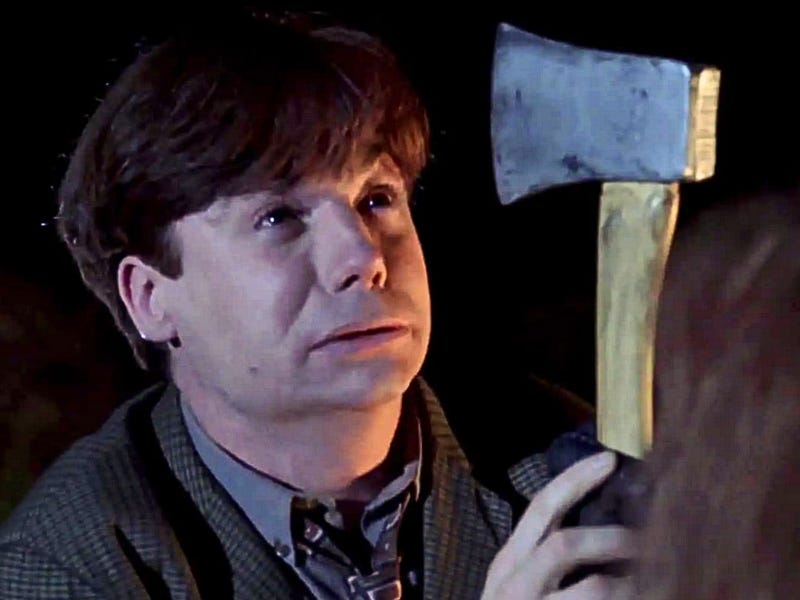
One of my favorite comedy movies is So I Married an Axe Murderer, the extremely quote-worthy flick from 1993 starring SNL alumni, Mike Myers. For those who haven’t seen it (and shame on you if you haven’t), the film follows Charlie MacKenzie (Myers), a San Francisco poet with a long history of failed relationships. In local butcher, Harriet Michaels (played by Nancy Travis), he believes he’s finally found “the one.” There’s just one problem. A series of revelations lead him to suspect that Harriet murdered three men. (Yes, it’s awkward). But when a different woman later confesses to the murders, a relieved Charlie proposes to Harriet. The two get married and travel off to a secluded mountain hotel for their honeymoon. Their future looks bright.
Not so fast… Charlie’s best friend, Tony (Anthony LaPaglia), a police detective, learns that the woman who confessed to the murders is a compulsive liar. He also discovers incontrovertible links between Harriet and the murdered men. He manages to warn Charlie over the phone, but a storm takes out the line a second later. Tony rushes to the hotel to save his friend. Meanwhile, acting on Tony’s warning, Charlie has locked Harriet in the closet of their hotel room… only to find himself under attack by Harriet’s sister, the real murderer (unbeknownst to Harriet until that moment), who, axe in hand, chases Charlie through a window and onto the roof.
When Tony arrives on the scene, he’s still convinced that Harriet is the murderer. He breaks into the two’s room and releases her from the closet, bet refuses to take seriously anything she’s telling him about what’s really going on. He ties her up and begins interrogating her. And staying true to the comedic spirit of the film, he continues to smugly dismiss her claims, and maintain the cool confidence of an investigator who’s figured it all out… even as Charlie is audibly still being attacked by the sister directly above them.
I’ve been thinking about that scene a lot lately… in the context of U.S. politics.
Those who’ve seen the film (and good on you) know that Tony’s a good guy and a good friend. He’s a regular dude who wants personal fulfillment from his chosen career. In this instance, he’s focused on the matter at hand, and enjoying a momentary victory — blissfully tuned out and unaware of the far more dramatic events unfolding around him. This is his time to shine. Everything else is background noise.
I believe that Tony represents a large portion of the American public — at least in how those individuals view U.S. politics in the year 2025. They’re focused on their own lives and ambitions, and have become numb to all the axe-swinging and desperate shouting that represent the chaos and daily theatrics that have dominated the political scene for several years now. They’re no longer convinced that any of it matters, despite the impassioned warnings and expressed frustration from the Harriets of the world (who would include yours truly and other attentive political observers).
But lets get back to the Tony-types. They do have a defensible (or at least understandable) case to make. Despite all the doomsday warnings of the past 25 years, the country is still here. We survived 9/11, multiple wars, the Great Recession, Obamacare, a global pandemic, an insurrection at the Capitol, and a mentally incapacitated leader of the free world. We’re here despite the loudest critics of George W. Bush, Barack Obama, Donald Trump, and Joe Biden. And regardless of what all happens in this second Trump term, our country will still be kicking, and very likely enjoying a better quality of life than most of the world, when the next president is sworn in a little over three years from now.
So… why should the Tonys pay attention, at least to the things that don’t, in this very moment, directly affect them? Why should they think beyond stuff like… oh, let’s say the price of groceries, the cost of healthcare, and maybe the excesses of wokeness that make them feel uncomfortable and off-balance in their daily lives? What’s the worst that can happen if they just blow off the rest? After all, we have a constitution, multiple branches of government, term limits, and the rule of law that will keep anything too crazy from happening… right? The other stuff will just kind of work itself out… Right?
The problem with that attitude, in the context of the film anyway, is that an innocent person being attacked with an axe by a homicidal maniac is morally and ethically unacceptable — a matter of life and death that, in a civilized and just society, demands immediate attention. Yet, for comedic purposes, Tony has, for all intents and purposes, normalized it. He has found his comfort zone, and doesn’t want to leave it.
It’s an amusing scene, for sure. It would be far less amusing in real life.
Some of you may be familiar with Nick Catoggio over at The Dispatch. He’s a conservative who writes a lot of sobering pieces about the modern era of politics we’re currently in. One from last week has stuck with me more than others. It had to do with the American public largely no longer caring about things they would have found totally unacceptable just a few years ago, because the outrageousness of our politics has effectively normalized it.
Catoggio isn’t talking about political rhetoric or personal conduct. That ship sailed a long time ago. Millions of Americans only meaningfully revisit the topic in the wake of political violence… only to summarily disregard it a few days later.
No, he’s talking about institutional matters as they relate to legality, corruption, and how our nation is governed — at least at the federal level.
“What the president is learning, day by day, is that the American people have a much higher tolerance for authoritarianism than anyone thought,” Catoggio writes. “And so every transgression that fails to meet popular resistance invites another. The envelope will be pushed until that resistance emerges or Trump does something so unthinkable, like suspending an election or ordering troops to attack protesters, that resistance becomes too frightening to contemplate.”
Before I go further, let me head off a couple of expected lines of attack from Trump loyalists and others reflexively inclined to defend the president from criticism: Yes, I’m aware that Donald Trump is not literally a king, and I have no interest in the “No Kings” protest stuff, which is more of a hodgepodge of gripes (some legitimate, some unserious, and some pretty messed up) than a cohesive message of dissent. Also, spare me your whataboutism. For four years, I called out President Biden’s executive overreach and acts of corruption whenever I saw them. I did the same with Obama. Their infractions don’t justify those of their political opponents.
Trump is our current president, and he will be for a few more years. What happens during this term — both the good and bad stuff — matters, and may have long-lasting consequences for our country.
Now, suffice to say (unless you’re like Tony, and don’t want to hear it), Trump 2.0 has been, by any objective measure, far more authoritative, dismissive of the rule of law, and nakedly corrupt than what we saw during his first term. Yet, his approval rating remains roughly unchanged. In fact, it’s right at his first-term average.
From openly accepting bribes, to openly instructing his DOJ to go after political adversaries (and the law-firms representing them), to openly purging federal law-enforcement officers and litigators whose assignments he didn’t like, to openly extorting or otherwise strong-arming insubordinate media organizations, to openly stripping security clearances (and in some cases protection) from critics, to openly demanding hundreds of millions of dollars in “restitution” from the Justice Department, to openly changing I.R.S. rules to more easily target left-leaning groups, to openly refusing to enforce laws he doesn’t like, to openly abusing the pardon power on a massive scale, to openly treating the presidency as an infomercial opportunity, to openly applying Pentagon press restrictions that prevent independent reporting, there’s just not much of a public appetite for caring… except from — again — the politically-engaged Harriets.
And roughly half of those who are politically engaged don’t really care either… since Trump gets an obligatory pass from them for being Trump. Concerns like the ones I listed, which have little to do with political ideology — and a lot to do with ethics, norms, and legality — are reflexively dismissed as “leftist” or a symptom of “TDS.” And they’re done so by people who would find those concerns just as alarming as I do if they had been committed by a Democrat.
I could add to the list Trump’s efforts to send National Guard troops into U.S. cities against the wishes of state governors, his private-sector nationalizations and central planning, his whimsical screwing with the U.S. economy with unilateral tariffs (with special exemptions and advance notice for friends), and masked ICE officers (whether you support their broader assignment) too often confused about who they’re apprehending and which uses-of-force are legal. I’m just not sure it would matter any more to the average person than all of that axe-chopping, shrieking, and impassioned pleas meant to Tony.
Catoggio writes, “As for why the rest of America got comfortable with authoritarianism, you can speculate as well as I can. ‘Sheer exhaustion,’ one might say, reasoning that it’s hard to get angry about Watergate when a new Watergate happens every day. Or ‘media silo-ing,’ you might theorize, as Trump-friendly outlets suppress information that might cause viewers to turn against the president’s program…”
Catoggio offers even more depressing explanations, but I think the first two have merit —especially the first once, in how it relates to the politically disengaged. I mean, if the horrific racket above Tony’s head were there all the time, one might understand how he — or anyone else for that matter — could find a way to tune it out.
Still, I would hope everyone reading this would agree that something of that magnitude should not be tuned out. People should care. Likewise, people should hold the freedoms, institutions, and ideals, that have made this country great, in high enough regard to at least notice what’s happening to them, and maybe even pressure their members of Congress to do something about it.
Because if you’re relying on the mechanisms that are currently being tested (and in some cases tossed aside) to keep things from getting too far out of hand, it may come to be that the stalwart protections you take for granted today won’t be there tomorrow.
And it won’t be a laugh line.
Seems to me that Trump has been able to build a base of supporters who are authoritarian minded and find comfort in some measure of dictatorial rule. I don't believe this mind set is limited to one party. Is it possible pollsters keep missing the boat on Trump popularity by not testing for this in their surveys?