


Last month marked the end of President Trump’s first year back in office, and whether you largely like or dislike the job he’s done during that time, one thing’s for certain: it was year of consequence.
Lots of Trump supporters take exception to my criticisms of the president, but unlike many of his critics who reflexively oppose anything and everything he does, I’ve recognized and praised a number of his achievements. Two of his most significant ones, in my view, have been his strong support of Israel (including his bombing of Iran’s nuclear facilities), and his control of the southern border.
But with the good, there’s been a lot of bad.
With the administration’s one-year anniversary still visible in the rearview mirror, I figured it would be a good time to look back on a piece I wrote in November of 2024, shortly after Trump won the election, detailing my four biggest concerns with his return to the Oval Office.
Were my worries back then warranted and rational? Or were they misguided and overblown?
Let’s find out.
Staffing
In the November 2024 piece, I looked back on Trump’s surprising 2016 presidential victory, and how he came into the White House as a novice. It’s clear that he hadn’t expected to defeat Hillary Clinton, and thus hadn’t put much previous thought into who should fill cabinet positions and other leadership and advisory roles in his administration.
That ultimately ended up being a good thing, because he relied heavily on the GOP establishment, among other things, to guide him through those selections. The result was the installation of a number of qualified people who, as it would turn out, steered him away from his worst impulses. It was a full-time job, according to some of his highest-ranking advisors (including distinguished U.S. generals), but the country benefited from it.
I had no such confidence in his staffing selections this time around, predicting that he would instead “avoid any perceived acts of insubordination or disloyalty by mostly surrounding himself with slobbering sycophants committed to nurturing his ego and egging on his autocratic tendencies.”
Well, a year into Trump 2.0, let’s see how that panned out…
I’ll start with the good.
I think the inarguable standout performer in this administration has been Secretary of State Marco Rubio. He was a good pick, and despite his well-documented toadying, I’ve always felt him to be credible. I greeted his cabinet nomination, and so did the U.S. Senate who unanimously confirmed him.
Do I like seeing Rubio (who I would have happily voted for president in 2016) have to publicly grovel before the president, lavish him with embarrassing adulation, and sink into Oval Office couches while Trump and Vice President J.D. Vance discredit themselves on the world stage? Of course not. But as a buddy of mine stated a few weeks go, “A groveling Marco Rubio is the closest thing we have to competent leadership in this administration.” And I think Rubio has proven that with his handling of Venezuela and Gaza, among other issues.
Much of the rest of the cabinet has been… a different story.
Pam Bondi was certainly a better pick than Trump’s initial choice for U.S. attorney general, Matt Gaetz (who was under investigation for, among other things, drug abuse and sexual misconduct with a 17-year-old girl). But Bondi has spent much of the last year reshaping the Department of Justice to align with Trump’s personal priorities, including targeting his political opponents for retribution, and staving off her once adamantly promised release of the Epstein files — initiatives Trump has reportedly complained she has been too slow and ineffective at.
Tulsi Gabbard’s useful idiocy for tyrannical enemies of the United States, including Bashar al-Assad and Vladimir Putin, should have disqualified her from any cabinet position, let alone National Intelligence Director. Yet, that’s what she became. Within just weeks of her confirmation, she absurdly testified that Iran was not working on a nuclear-weapons program. Since then, the White House has seemingly insulated her from serious national intelligence matters, and placed her on election conspiracy-theory investigations, rather than taking the appropriate (but self-incriminating) action of removing her from office.
Though relatively quiet lately, former Fox News host and current U.S. Defense Secretary Pete Hegseth has committed all kinds of unforced errors, between his recklessness, performative buffoonery, legally questionable military initiatives, and lack of transparency. Secretary of Homeland Security Kristi Noem is in hot water, and may be thrown under the bus by the administration for her egregious handling of ICE operations and controversies; same with Homeland Security Advisor Stephen Miller. Scott Bessent and the Epstein-friendly Howard Lutnick may be smart guys, but whether you blame or credit them for the administration’s economic policies, they seemingly can’t make it through a single interview without saying something objectively false, economically illiterate, or borderline insane.
In the November 2024 piece, I wrote:
I’m also concerned that Trump will fulfill whatever transactional agreements he made with people like Elon Musk and Robert F. Kennedy Jr. for their political support… and not just because those guys are fellow conspiracy theorists and disinformation artists. With Musk, I worry about his stronghold on government contracts and possible conflicts of interest in his dealings with other countries (including Russia). With Kennedy, a crackpot anti-vaxxer who thinks we should rid drinking-water of fluoride, I worry about the future of public health.
Of course, Elon Musk ended up heading DOGE, which turned out to be a colossal and very costly failure. RFK Jr., having already broken the major promises regarding vaccine policy that secured his confirmation, is (in addition to regularly spouting out made-up health statistics and diagnoses) currently presiding over our country’s worst measles resurgence in over 30 years.
Tariffs and Spending
In the November 2024 piece, I described how the economically illiterate fiscal policies Trump was running on “relied heavily on imposing huge tariffs that would neither be paid by who Trump says they will, nor address the problems Trump claims they would fix.” I added, “Every independent score revealed that they would instead drive consumer prices through the roof and hurt the U.S. economy… Trump’s policies would also broadly expand government (as they did last time), and add several trillions more to the national debt…”
Well, the latest numbers show that the U.S. trade deficit — the elimination of which has been a key argument for Trump’s tariffs — has gone in the opposite direction. It doubled in November, shooting to a higher number than a year earlier. As my regular readers know, I couldn’t care less about trade deficits (since they broadly don’t matter and aren’t an actual problem), but the discrepancy between the administration’s rhetoric and the actual results of their continually in flux trade policy is worth pointing out.
Something that does matter is jobs. The administration promised that Trump’s tariffs would create more manufacturing jobs in the United States. Instead 72,000 manufacturing jobs have been lost since “Liberation Day,” with domestic manufacturing output in decline.
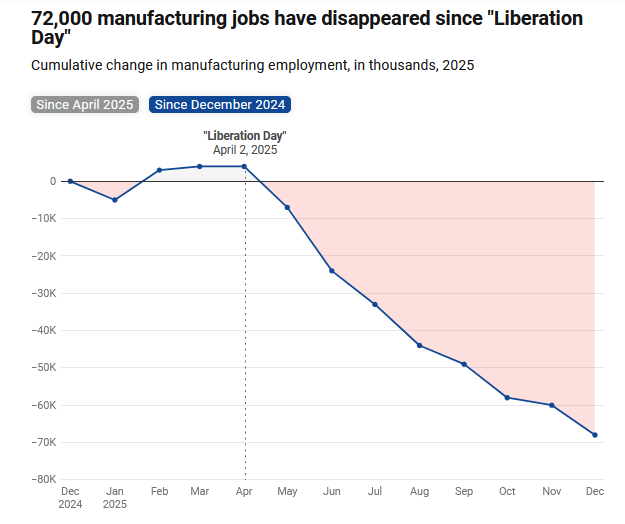
The good news is that the inflation rate hasn’t gone up. It’s roughly the same as when President Biden left office. The bad news is that consumer prices continue to rise on the backs of Trump’s tariffs (an estimated $1,500 per household), which largely aren’t included in the inflation rate because they’re transfers on specific goods.
In other good news, Americans continue to spend money in this economy, despite higher costs (which is helpful to our GDP). In other bad news, they’ve been increasingly dipping into their nest eggs to pay for things. Americans’ personal savings have dropped by a whopping 37% since “Liberation Day.”
While the stock market has thus far navigated the situation pretty well (largely thanks to AI technology and production), U.S. business investment remains in a state of paralysis, foreign tariff retaliation continues to hurt American exporters, longstanding trade partners are leaving us for China, and U.S. farmers are becoming increasingly reliant on federal bailouts. Oh, and the national debt has risen by about $2.5 trillion since Trump was sworn back into office.
I’d say that the best thing about Trump’s trade policy has been his (albeit reluctant) willingness to repeal his own worst tariffs whenever stalwart economic pillars look about ready to crumble. Then again, that’s like giving credit to someone, who’s hitting himself in the head with a hammer, for momentarily putting the hammer down.
Ukraine
In the November 2024 piece, I wrote:
A Trump/Vance administration should very much concern those who believe it’s vitally important that Putin’s war-crime-ridden invasion of Ukraine ultimately ends in defeat. Trump’s well-documented man-crush on the Russian president, his history of playing games with Ukraine defense-funding (and accusing them of U.S. election interference), and his invitation to Putin to attack our NATO allies are far from the only suggestions that Trump will abandon our ally.
Trump couldn’t even bring himself to say at last month’s presidential debate that it would be good if Ukraine won. Last week, he parroted Russian talking points, declaring that “Ukraine is gone. It’s not Ukraine anymore,” and that “any deal, even the worst deal, would be better than what we have right now.”
Clearly my assessment back then was… optimistic.
I’ve written a lot about U.S. policy on Ukraine over the last year, from Trump’s blaming of Ukraine for being invaded, to the disastrous Oval Office meeting, to our president’s knee-capping of Ukraine’s defenses at crucial moments. I’ve talked at length with Ukraine and foreign policy experts on the matter to get the clearest possible understanding of the situation. And my takeaway from it all is that Trump returned to office perfectly willing to surrender Ukraine to Vladimir Putin (as his solution to “end” the war), and he’s still effectively working toward that end. Unlike most of Europe, Trump doesn’t understand (or can’t bring himself to care about) the larger global implications of a Russian victory in Ukraine. Putin has taken full advantage of the situation, regularly upping Russia’s attacks in response to Trump’s occasional, half-hearted warnings and continued attempts to charm and flatter him.
Ukraine, however — while prepared to make painful concessions to bring a meaningful and sustainable end the violence — isn’t going to relinquish its sovereignty or preemptively abandon key regions and major cities that would only give Russia a stronger foothold for seizing the rest of the country (and beyond) in the future.
A year into Trump’s second term in office, the United States is still refusing to come down on the obviously correct side of this historic, globally consequential conflict. And it’s a very dangerous thing for the free world.
Character and Hostility Toward the Constitution
In the November 2024 piece, I reviewed how Trump ended his first term in office by trying to overturn our country’s system of democracy to stay in power, and provoking a violent attack on our legislative branch of the federal government with two months of lies.
I wrote, “No election result will ever negate Trump’s profound character problems and the chaos he has created within our country’s institutions and constitutional order.”
Having never been held meaningfully accountable for those actions, and receiving and an additional layer of legal protection from the Supreme Court, I was naturally concerned he would test what else he could get away with.
“From his perspective, he is now completely untouchable,” I wrote. “And with his ego, lack of moral compass, and past willingness to strike at the heart of our nation’s founding principles, institutions, and rule of law, that should concern many more people than it does.”
Suffice to say, Trump’s been testing all kinds of institutional norms and legal framework since returning to office. Trump 2.0 has been, by any objective measure, far more authoritative, dismissive of the rule of law, and nakedly corrupt than what we saw during his first term.
A lot of it has been right out in the open, like accepting bribes, instructing his DOJ to go after political adversaries (and the law-firms representing them), purging federal law-enforcement officers and litigators whose assignments he didn’t like, extorting or otherwise strong-arming insubordinate media organizations, stripping security clearances (and in some cases protection) from critics, demanding hundreds of millions of dollars in “restitution” from the Justice Department, changing I.R.S. rules to more easily target left-leaning groups, personally suing the I.R.S. for billions, refusing to enforce laws he doesn’t like, abusing the pardon power on a massive scale, routinely treating the presidency as an infomercial opportunity, applying press restrictions that curtail independent reporting, obscenely abusing the IEEPA (including for personal benefit), partially nationalizing production-companies, threatening the sovereignty of our international allies (at the risk of destroying the NATO alliance), and most recently calling for the nationalization of U.S. elections.
And that’s just some of the stuff we know about!
Americans are certainly free to dismiss all of this, of course, and despite public sentiment increasingly turning against the president, many are still doing just that — whether its because they’re too busy in their lives for politics, don’t think they can do anything about what’s happening, are actually fine with an authoritative Donald Trump doing whatever he feels like doing (institutions be damned), or have convinced themselves that — no matter what — a Democratic president would be worse.
But Americans should care what their elected leaders do with the power bestowed upon them (regardless of what’s felt about their political opponents). And Americans should be concerned when their leaders abuse their power. Because without concern and accountability, the abuses will only worsen and grow more bold.
I’ve lost all faith in anyone holding their side accountable. And I never thought I’d say this, but the right is worse. Or at least, I despise it more from the right because I’m on the right and hate seeing this clown show they’ve become. I’ve only seen political dialogue get more ignorant and partisan
John- Wow, that was a booklet of information and I must say- your crystal ball is very crystal clear. Such keen insight you have, but a huff and a puff won't "blow the house down." That might take an army of who knows what- which leads me to my question of the week for you : What are your feelings and opinions for the next twelve months? Any military actions will be viewed in a negative light. Firing any cabinet members as well. It's "politics" until the midterms? I think so.