


Last Friday for the Reagan Caucus Podcast, mere hours before the United States and Israel launched Operation Epic Fury on the Iranian regime, I had the opportunity to co-interview National Review’s Noah Rothman on the attack he believed he was imminent.
Rothman writes a lot about, and is extremely well-versed in, U.S. foreign policy. I always find his perspectives valuable, and Friday was no different. We discussed the build-up of military assets in the region, the historic justification for upping the ante on Iran, the goal and possibility of regime change, and the public perception of what was to come.
The latter is something I think about whenever there’s a U.S. military operation abroad — mainly for reasons I discussed with Bernie Goldberg on last week’s No BS Zone. Americans typically don’t pay much attention to foreign policy unless they’re forced to. And up until that point, in addition to side-stepping congressional approval for an operation in Iran (which I believe was a mistake), the Trump administration hadn’t made much of a public case for what they were about to do. This, despite there being a strong case to make (including Iran being responsible for the deaths of hundreds of Americans).
Sure, a couple officials had once again evoked Iran’s nuclear program, but as Rothman explained on Friday, it was a hard argument to make due to the success of Operation Midnight Hammer last summer:
Senator Ted Cruz made the same point after the operation began.
While I have no doubt that Iran’s nuclear ambitions hadn’t been deterred, their nuclear capabilities certainly had been (at least for the foreseeable future). I think the real hesitancy to appeal to Americans (beyond the abstract), and let the case simmer in the court of public opinion, was muscle memory from the Iraq War a couple decades earlier. Iraq was a much more complicated conflict, under different circumstances, that required a large deployment of ground troops.
That’s probably also why the Trump administration launched Midnight Hammer under what was apparently the false predicate that Iran was planning to preemptively strike the United States.
But Iran is not Iraq, and U.S. and Israeli military and intelligence-gathering capabilities are far more advanced than they were 23 years ago. The broader situation in the Middle East is also quite different. More of Iran’s neighbors, due to the growing threat Iran posed to them, had built strong working relationships with Israel and the United States (a lot of it behind the scenes). Since the October 7, 2023 attack on Israel, the IDF (with help from the United States) had dealt tremendous blows to Iran’s terrorist network. With Iran’s nuclear program sidelined, and the country’s domestic uprising that began earlier this year, America and Israel were left with arguably the best opportunity they’ve had in decades to remove the regime. And to everyone’s credit, they took advantage of it. Congratulations, President Trump. Congratulations, Prime Minister Netanyahu.
We’ve been watching the operation play out since then, thus far with a good amount of success.
Is regime-change a foregone conclusion in Iran? No (though much of the regime’s leadership has thankfully already been decimated). This is war. War is complicated. War is hell. Conditions will change. Unforeseen circumstances will arise. There’s already a good amount of confusion as to the administration’s goals and commitment to the cause. And of course, a lot’s going to depend on the will of the Iranians, and their ability to organize and take back their country.
I wish them the best of luck.
I support this effort, and am glad we’ve embarked on it. I’m praying for the safety of our troops, our allies, and the Iranian people.
While we watch as the situation continues to unfold, I think it’s worth reflecting on some of the politics (and related irony) that led us here.
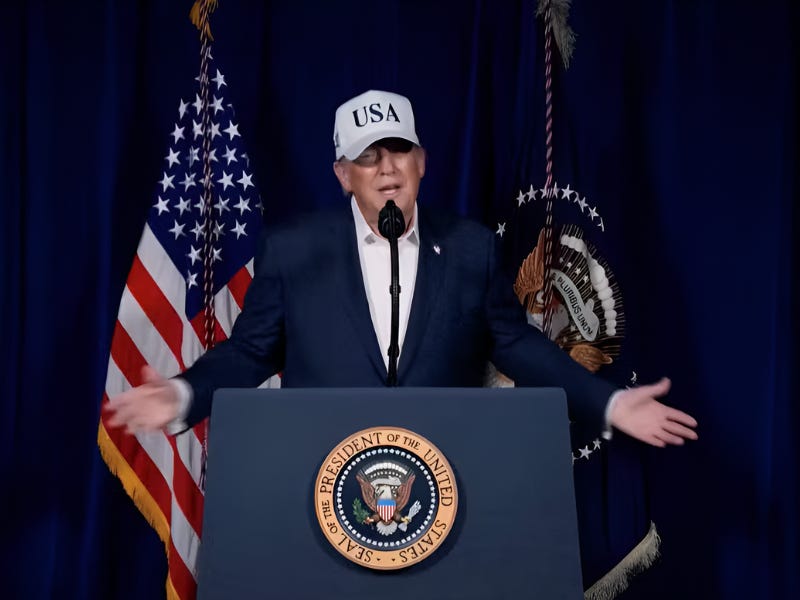
As I first pointed out last June, shortly after the president bombed Iran’s nuclear facilities (another operation I supported and congratulated him on), Donald Trump, his vice president, his family, and his most fervent supporters (in and out of the media) have spent the last several years casting Trump’s Republican and conservative opposition (including yours truly) as bloodthirsty, globalist, warmongering neocons. You may remember that MAGA-world bragged about Trump never starting a war, along with his opposition to regime-change in the Middle East. They claimed that folks like Nikki Haley, John Bolton, and Liz Cheney were downright dangerous, and far too prone to using the U.S. military abroad. Trump, on the other hand, was the “Peace President.”
Well, despite all the Code Pink talking points, it turns out that the Peace President has now ordered military strikes against more nations than any U.S. president in the modern era — seven countries in total. And Trump ordered more air strikes in 2025 alone than “Sleepy” Joe Biden did during his entire four-year term.
I’m not complaining about those strikes, mind you. I’m not the one who ran for office on what was effectively an anti-war platform. But it’s been very amusing to me to watch all of the backtracking in MAGA-world on this… in just a few short days! It’s been even more amusing to watch the always-principled, Trump-maligned John Bolton basically taking a victory lap over Operation Epic Fury (including telling CNN the other day, “My only regret is that I wasn't persuasive enough in the first term to get to this point.”).
Bolton might just be the most politically-vindicated man in Washington, and I love it.
Again, I’ve largely approved of these military operations, I pray the regime in Iran is toppled, and I hope the Iranians live happily ever after in some form of democracy.
But in the interest of intellectual and ideological consistency, especially in MAGA-world, shouldn’t we finally change Trump’s nickname from the “Peace President” to “Neocon Don”?
It even has a good ring to it.
The jury's still out. As usual, the war in Iran will be judged by the end results. If things turn out spiffy, President Trump will be hailed as a mighty leader with keen foresight and a spine of steel. If things go south, President Trump will be seen by most as reckless and feckless, despite his effort to shift the blame or to sugar-coat it..
What a freekin' mess. Whether it was the right or wrong thing to do seems moot now. The stakes are incredibly high, and this has the very real possibility of spiraling out of control. Adding Trump's penchant for lying and making grandiose and stupid comments does not likely help.