


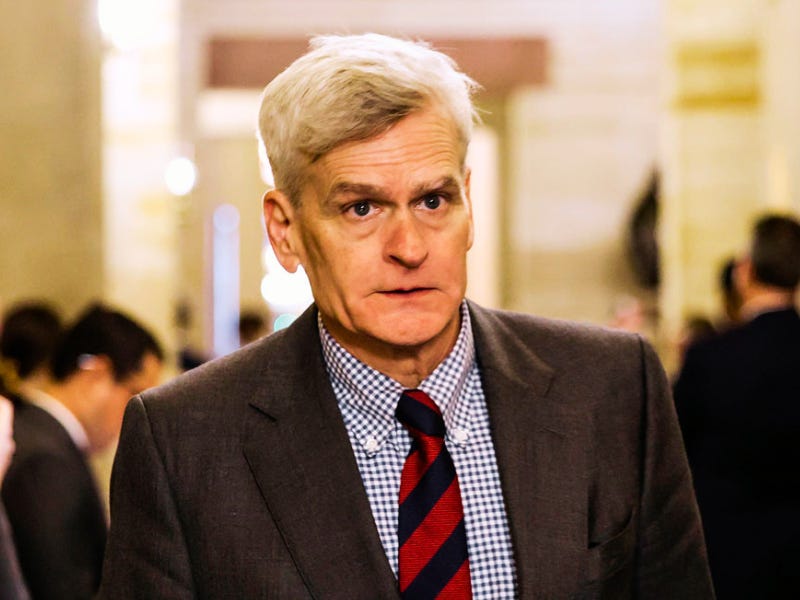
On February 13, 2021, Senator Bill Cassidy (R-LA) was one of just seven Republican senators who voted to convict former President Trump on his impeachment for inciting the January 6 attack on our nation’s Capitol.
“I voted to convict Trump because he is guilty,” Cassidy boldly stated at the time, surprising many political observers who’d predicted he’d side with the president.
It was the correct decision — a patriotic one that required defying the North Star principle that had defined his political party over the previous four years: unconditional loyalty to Donald J. Trump.
Still, Cassidy probably figured his vote would be less politically problematic for him than for other impeachment-supporting Republicans. He had just been reelected for another six-year term. While GOP primary voters were sure to punish pro-impeachment members of the House (like Liz Cheney) a year and a half later, Cassidy would be afforded over half a decade for his deep-red Louisiana constituents to snap free of the MAGA spell, and heal from the bitterness of Trump’s defeat.
But Republicans, by and large, weren’t ready to move on. In service to Trump, the GOP effectively codified the false claim that the 2020 election was stolen (or at minimum, “rigged”). Many Trump supporters even let themselves be duped (by the Tucker Carlson wing of the Right) into believing that January 6 was a false flag operation, or perhaps something no more serious than “peaceful grandmothers” taking a “self-guided tour” of the Capitol. In which case, Trump couldn’t possibly be blamed for his actions during that time, and was naturally deserving of another shot at the White House.
Trump won the 2024 primary race in a landslide, and when a Biden-weary electorate handed him his second general-election win a few months later, Cassidy knew the situation wouldn’t bode well for his 2026 reelection hopes.
After all, the senator had seen what had happened to his Republican colleagues who’d likewise supported Trump’s impeachment. Only two of the ten House members remained in office, and Lisa Murkowski, the only pro-impeachment GOP senator who’d won reelection since then (despite Trump’s best efforts), did so through a complicated ranked-choice voting system.
Suffice to say, Cassidy had a tough political decision to make. If he was determined to follow through with his reelection plans, he would have to go down one of two avenues:
Continue to responsibly serve in the Senate with honor and distinction, run on that record, and hope for the best.
Grovel at Trump’s feet for the next year and a half, and pray that — unlike in every other circumstance — he would receive forgiveness for his impeachment vote, and not face political retribution.
Neither strategy was going to spare Cassidy’s political career, but at least with the first one, the senator would have been able to leave office with his head held high, knowing he had done right by his country (and his conscience), and ended his tenure with a political legacy to be proud of.
He instead chose the second, convincing himself that he could somehow get back in the president’s good graces by becoming a born again Trump sycophant, similar to how JD Vance, Lindsey Graham, Ted Cruz, and other former Trump critics and rivals had managed to.
But it wasn’t enough for Cassidy to simply engage in the same cringe-worthy, over-the-top flattery that his Republican colleagues were all too comfortable with. He felt he needed to also surrender his better judgment on the most consequential decision he would make in Trump’s second term: the confirmation of Robert F. Kennedy Jr. as Trump’s Secretary of Health and Human Services nominee.
As I detailed back in January:
Cassidy, a highly-respected physician, had expressed deep-seated concerns over [RFK Jr.]. What Cassidy especially found troubling was Kennedy’s long history of nutty vaccine-skepticism (which Kennedy had a financial stake in), and his favoring of wild speculation and rhetorical anecdotes over proven health science. It was quite obvious during the confirmation hearings that Cassidy knew Kennedy was not only grossly unfit for the job, but could even be dangerous with that level of public power.
Cassidy had a moral, ethical, and patriotic responsibility to vote no on RFK Jr. Doing so would have only meant that Trump would have to nominate someone else (like he did after the Matt Gaetz debacle). But that would have embarrassed the president, and been seen as another act of defiance. Cassidy, I’m sure uncomfortably so, prioritized his reelection hopes. He caved to pressure from the White House, and became the deciding vote to confirm Kennedy.
It was a dereliction of duty, plain and simple. The same is true of every other senator that supported Kennedy’s nomination, but Cassidy, more than anyone else (because of his background), knew better.
Cassidy tried to rationalize his controversial decision, saying that Kennedy had offered him assurances that he would never dismantle our country’s vaccine safety systems or remove government guidance for vaccines. But the senator seemed unconvinced by his own words… and with good reason. Within mere months, Kennedy had done both, and he’s spent the last year falsely diagnosing various health conditions with witch-doctor quackery, and defunding promising mRNA research.
Oh, and as expected, Trump urged an election-denying primary opponent into Cassidy’s race, and quickly endorsed her. As GOP primary voters were heading to the polls last Sunday, Trump even got in some extra shots at Cassidy, calling him a “disloyal disaster,” a “sleazebag,” and a “terrible guy.”
When all was said and done, Cassidy got less than 25% of the primary vote. He finished in third place — a two-term incumbent senator who’d won both of his previous statewide elections by double digits.
It’s hard to imagine how Cassidy could have foreseen any other ending. Maybe he figured that if people who’d publicly compared Trump to Hitler could wind up as high-raking members of the Trump administration (as JD Vance and RFK Jr. both did), there was, as Jim Carrey’s character in Dumb and Dumber might have said, “a chance.” But in the president’s mind, even the most disparaging rhetoric is a far lighter infraction than someone using their constitutional authority to hold him accountable for his actions, or even just to prevent him from doing something he really, really, really wants to do.
Following his loss, Cassidy has said he doesn’t regret his impeachment vote — a position he’d been less candid about in recent years. “I had the privilege of voting to uphold the Constitution, isn’t that a great thing?” he told reporters the other day.
What he hasn’t said, despite offering several criticisms of RFK Jr., is whether he regrets voting to confirm him as our HHS Secretary. I’m not sure he has to say anything about it — at least not for my benefit. I’ve seen the answer written across his face every time he’s been asked about the issue, or has faced Kennedy, in the time since.
I suspect this political era will end with many regrets, hallmarked by the blinding allure of political longevity. I think that’s already shown to be the case.
Anyway, Cassidy has another eight months left in office. I suspect he’ll probably use that time the same way that Sen. Thom Tillis (R-NC) has since announcing his retirement last year: taking principled positions, pursuing conservative policies, and speaking his mind (regardless of what Trump and his supporters think about it). And in doing so, Cassidy may even manage to clear some of his conscience, and salvage a bit of his reputation.
But it won’t repair the damage caused by his unwillingness to once again do what was right when it really mattered.
Trump: 'I love getting even with people' (1992). Trump tolerates nothing less than 100% forever loyalty to himself. That goes for everyone, including family. Let this be a lesson to everyone.
Senator Cassidy needed to go. He didn’t support President Trump.