


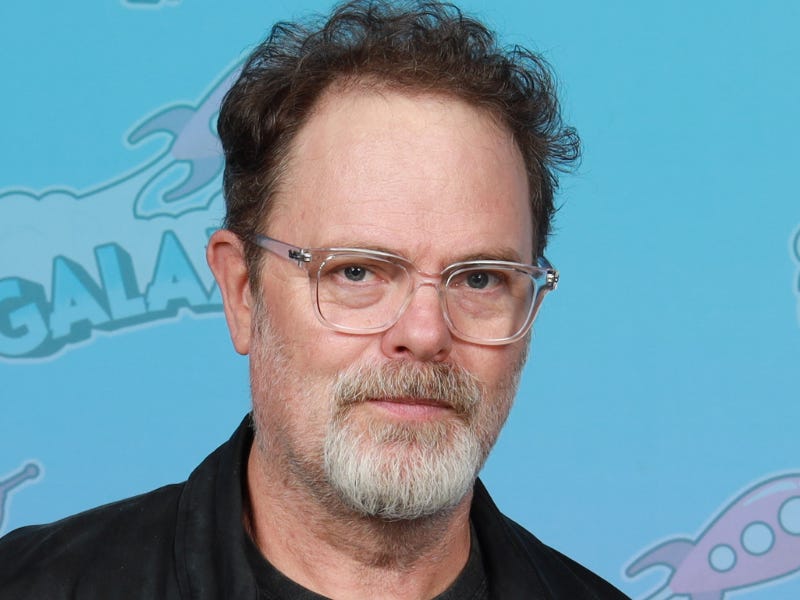
Over the holiday weekend, a video clip of actor Rainn Wilson made the social-media rounds. Wilson, best known for his longtime portrayal of Dwight Schrute on NBC’s The Office, had some choice words for British comedian, Ricky Gervais.
Speaking on his podcast, Soul Bloom, Wilson evoked the famous opening monologue from the 2020 Golden Globe Awards, in which Gervais (who hosted the event) brutally roasted the celebrity elite in attendance. Perhaps Gervais’s most memorable line of attack that night was aimed at actors and actresses who use their award-speeches to go off on political rants.
“So if you do win an award tonight, don’t use it as a platform to make a political speech,” said Gervais. “You’re in no position to lecture the public about anything. You know nothing about the real world. Most of you spent less time in school than Greta Thunberg. So if you win, come up, accept your little award, thank your agent and your God, and fuck off, okay?”
The cameras captured a mix of audience reactions, including nervous laughter, appall, and even anger. Lots of folks watching from home, however, found the display uproariously funny.
Wilson wasn’t one of them. Speaking six years later about the incident, Wilson said:
“One of the things that pisses me off to no end is Ricky Gervais saying, ‘Just take your actor award. No one wants to hear what you have to say.’ It’s like, Fuck you. Bullshit. Guess what… Everyone gets to say what they want to say about anything. Gaza, climate change, politics. You get to say it. If you’re a truck driver, you get to say it. If you’re a school teacher, or you’re winning an award… We have free speech… Why would you try to shame and silence someone from speaking their truth?"
Wilson added that he believed people who speak about politics should at least do some research, so that they know what they’re talking about (as opposed to just virtue signaling), but he reiterated his position that anyone should be able to say whatever they want.
I’m sympathetic to Wilson’s position, broadly speaking.
As I wrote a couple years ago, I used to buy into media-conservative mantras like “shut up and act” and “shut up and sing,” mainly because I had a visceral dislike of being lectured in the political arena by dolts who believed their celebrity status made then uniquely qualified to speak out on such topics. I think I was also a bit resentful of what I viewed as their undeserved, disproportionate political influence.
But over time, I came see them as no different than the right-wing cable-news hosts who routinely slam liberal celebrities for leaving their lane (while those same hosts fawn over right-wing celebrities who publicly agree with them).
“What moral or intellectual high-ground does someone like Sean Hannity have over a progressive actor to publicly weigh in on politics?” I posed in the piece. “Heck, the same could be said about me. Do I have any better argument for having my political views heard than Barbra Streisand and Bette Midler? Am I any more or less important, as an individual, than they are? Like them, I’ve never worked in politics (aside from some volunteer stuff). Does that mean I should I “shut up and write novels?”
Thus, I don’t really care anymore if a bunch of progressive actors and actresses use their platforms to sound off about politics, including at an awards show (even though one can effectively argue that it isn’t an appropriate time and place for politics in the first place).
But as someone who absolutely loved watching Ricky Gervais rake Hollywood over the coals that night — to their faces, no less — my position may be one Wilson hasn’t considered.
It’s not about whether or not someone has the right to speak out. Of course celebrities (like the rest of us) have the right to say what they want to say. What made Gervais’s monologue so fresh and welcome was that it was a long overdue display of irreverence toward a conformist industry that punishes political dissent within its ranks.
Case in point, one of today’s most politically outspoken actors is Mark Ruffalo. He’s far to the left of even your typical far-lefty, whether the topic is economic policy, the Middle East, the environment, “social justice,” Republicans, etc. He has said all kinds of politically controversial and offensive things over the years. Yet, it’s quite clear from his Hollywood resume that he has never paid any kind of professional price for it (and very likely never will).
Frankly, that’s fine with me. I think Ruffalo is a great actor, and I have no interest in him being cancelled over what I view as atrocious political positions.
Unfortunately, folks in Hollywood who lean right in their views aren’t afforded that luxury.
I’ve had some fun conversations lately with filmmaker, Howard Klausner, including one I recorded a couple weeks ago for the Reagan Caucus Podcast. Klausner found big Hollywood success early in his screenwriting career with 2000’s Space Cowboys. The critically acclaimed drama, led by an iconic ensemble cast (Clint Eastwood, Tommy Lee Jones, Donald Sutherland, and James Garner) grossed about $130 million, and really put Klausner on the map.
But before long, he found himself facing professional headwinds, as others in his industry grew suspicious that he was a conservative Christian (which he was, and remains).
“I got kind of soft-cancelled,” he told me. “I just stopped getting calls.” One Hollywood executive, who Klausner ran into years later, even admitted as much… and apologized.
Klausner has a healthy attitude about it all. He moved back to his hometown of Nashville years ago, and has gone on to create personally fulfilling, smaller-budget films. He loves his life, and is filled with gratitude for the successes he’s had.
But it’s worth considering that, unlike a long list of liberals in Hollywood, Klausner didn’t preach his views on a big, public platform (like a major awards show or a high-profile interview). He simply held those views — mainstream, traditional views that are still shared by millions of Americans. He was punished for them nonetheless, and his story isn’t a unique one in an industry that, as echoed by Wilson, claims to champion free speech.
Mark Ruffalo and company don’t know how well they have it. Or maybe they do, and they revel in being on the side of what is acceptable speech in the entertainment industry.
So yeah, I didn’t mind one bit when Ricky Gervais used his free speech rights (and comedic talent) to poke some holes in the Hollywood bubble. It was glorious.
Speaking of that bubble, Howard Klausner’s most recent film success was 2024’s Reagan, starring Dennis Quaid. The film, depicting the life of one of our nation’s most popular and consequential presidents, took 14 years to finally get to the big screen. This was, in large part, because major Hollywood studios had no interest in telling the story — at least not in a positive light. Despite around 70% of the nation still viewing Reagan and his legacy favorably, the film had to eventually be produced independently without Hollywood resources, and predominantly starred outed politically-right actors and actresses.
It grossed over $30 million.
I love movies but quit watching the awards shows years ago. It was like getting a leftist Amway presentation crammed down my throat in the middle of my entertainment dinner.
Academy Awards and the Golden Globe awards TV numbers are down 70 percent since their high-water marks. I suspect some of it has to do with celebrity political comments. It's hard to listen to people who tells others what to do but don't want you looking behind their curtain.