


Hi everyone.
Welcome to this week’s Daly Weekly, where I answer whatever questions you throw my way.
Let’s get right to your questions…
How was President Obama needlessly divisive? I asked you this once before but you didn’t answer.
Granted, one instance was when he said the Cambridge police responding to a possible break-in “acted stupidly.” That remark was stupid, and he stepped on the message of his press conference (I have no idea what it was). But he apparently learned from it. He had that “beer summit,” which was better than nothing. In the polarized aftermath of the Trevon Martin case he obliquely emphasized with those outraged by the acquittal but ended up by saying something to effect that we must respect the system. He hit the right cord. Once, in his 2008 campaign he made an off-hand reference to racial prejudice against him. Other that those two isolated instances I don’t know how he was NEEDLESSLY divisive. Many of his supporters were divisive, but that’s a different matter. — Bob H.
Hi Bob. I think you’re illustrating what Jessica Riedl was describing, in that most Obama supporters simply didn’t see it (though, as a longtime reader, I’m guessing you read at least some of my several writings on the topic years ago). I think it’s even more difficult for those people to see it in retrospect, now that we’ve been in the Trump-era of American politics for over a decade. Trump, like I stated in my original point, has been far worse, and more blatant about it (including borrowing techniques from Obama, and injecting them with steroids).
Anyway, if you want some examples of how I described Obama, here you go…
Obama liked to present himself as our country’s moral conscience. If you agreed with him, you were doing right by America. If you opposed him, you were a petty, uncaring person who was doing harm to our country and its citizens. Case in point, Obama and members of his administration liked to refer to their opposition as people who were “betting against America” and “on the wrong side of history.” Obama also made a habit of beginning sentences with, “There are those who say…” or “There are Republicans who say…,” and then finishing those sentences with a straw-man argument that no Republican (or anyone else) was making. His supporters would nod along, while righties understandably resented having false, demeaning positions assigned to them, from which Obama reliably declared the moral high-ground over.
This was a large part of his Obamacare campaign. He portrayed Republicans as cruel and callous for opposing his legislation, despite that legislation being opposed by most Americans, and premised on multiple false selling-points (including Politfact’s “Lie of the Year”). As someone who personally lost both his affordable insurance plan and his doctor as a result of Obamacare, I can’t tell you how frustrating it was to be told that my (and millions of others’) objection to it meant that I lacked compassion and wanted others to suffer.
On fiscal policy, you may recall that Obama, at one point, called a truce of sorts, inviting Republicans to present serious debt-reduction and entitlement-reform plans to him for a good-faith discussion. When Paul Ryan answered the call, Obama invited Ryan for a front-row seat to his speech on the topic. Obama then proclaimed from the stage (and to the world) that Ryan’s budget would essentially lead to the destruction of America, including letting bridges collapse and forcing autistic and disabled kids to fend for themselves. It was an epic double-cross, and a shameful display of hyper-partisan demagoguery. (By the way, recent studies have shown that Ryan’s rather modest reforms would have put our country on a much better trajectory — both with our national debt and entitlements). Glad we dodged that bullet!
As Bob Woodward described quite thoroughly in his book, The Price of Politics, Obama never made any serious attempt to work with Republicans, yet insisted at every opportunity that he was bending over backwards to accommodate them. It was pure gaslighting.
Obama spent the first two years of his presidency blaming every negative metric there was on the Bush administration. With the economy still struggling by 2012 (along with Obama’s poll numbers), Obama built his reelection campaign on a class warfare theme. He created corporate scapegoats and stoked jealousy among the electorate. Wealthy people were portrayed as villains who weren’t paying their “fair share,” and the middle class was told it was wealthy people (not failed public policy preventing a solid recovery) who were causing their fiscal woes. Obama even refused to denounce his super PAC for falsely accusing his Republican opponent, Mitt Romney, of somehow killing a cancer victim with his greediness.
The Obama administration went after conservative media figures like Rush Limbaugh, making them the face of their opposition. They declared that Fox News was not a legitimate news organization, warned other news outlets not to follow Fox’s lead, and even went as far as to trying to eliminate FNC's presence in the White House press pool (which other media organizations loudly denounced, and pressured an end to). The administration referred to the Tea Party as “teabaggers” (a sexually derogatory term), portrayed the movement as inherently racist, and called them “hostage takers” and “terrorists.”
And don’t even get me started on the “War on Women.”
I could go on and on, Bob, but I’m hoping at least some of these examples jog your memory. Unfortunately, a lot of Obama supporters still dismiss them (and many others) out of hand, and claim that Obama was only divisive to racists.
Others (as you did in a separate comment) like to evoke non-controversies like the “tan suit” stuff, in order to dismiss Republicans as being comically opposed to anything having to do with Obama. In reality, I can count how many people gave a s*** about Obama’s tan suit on one hand. As someone who watched way too many hours of Fox News back then, I hadn’t even heard of the supposed “scandal” until The Daily Show spliced together a handful of clips, and presented it as some big blow-up on the Right (which, again, it wasn’t). When lefties bring up the “tan suit” to dismiss criticism of Obama, it’s not much different to me than when MAGA folks dismiss criticism of Trump as people just objecting to his “mean tweets.” It’s a nonsense narrative.
Anyway, I’ve rambled long enough on this topic. You got your money’s worth this week, Bob. 😉
What do you think about political candidates running AI video-ads depicting their opponents saying and going things they’ve never done? I’m seeing more of that. — Ben G.
I don’t like it, Ben. AI has gotten so good in this arena (among others) that it’s almost impossible these days to the tell the difference between the real deal and a fabrication. I think that’s potentially dangerous, and not just in the realm of politics. Our country’s citizens already have a serious problem with unhesitatingly buying into propaganda and bias-confirming falsities. This type of thing makes it even worse.
I get the impression there was recently yet another round in the Dispatch vs. Bulwark wars, with some NR aligned people also getting in the scrum, apparently set off by Bill Kristol endorsing Court packing, which I find really confusing. I mean, I certainly think that Court packing is a stupid idea, to say the least. But I am a bit confused about why that specific comment inspired another round of fighting over Who Has The More Principled Approach To The Trump Era.
Personally, I think Bulwarkism is commendable in being anti- Trump, but lately they’re starting to forget *why* they’re anti- Trump, by playing footsie with illiberal ideas (like Court Packing) and elements on the Left (like Hasan Piker). And that although many individuals at NR have stuck to their principles, unfortunately the publication as a whole is, if not quite pro-Trump, anti- anti- Trump by focusing on and being way more outraged by examples of Leftist excesses than Trumpian ones.
I think TD is doing the best at balancing various principles, but even they aren’t perfect. I mean, this week they platformed Jeremiah Johnson, who wrote eloquently against Democrats embracing Hasan Piker ... Yet also recently encouraged people to vote for Graham Platner, because “control of the Senate is too important to risk”. I didn’t even realize until that post that Johnson is apparently a Democrat, but at least that is a defense against the charge that TD is engaging in the kind of performative anti- leftism that I certainly think NR does at times. — Aylene W.
Hi Aylene. There was indeed a big Bulwark/Dispatch online hullabaloo, though I didn’t see much Dispatch involvement in it. As you said, it began with Bill Kristol’s nod to court-packing, which drew criticism from National Review’s Charles Cooke, which led to Real Clear Politics’ Sean Trende making the below observation:
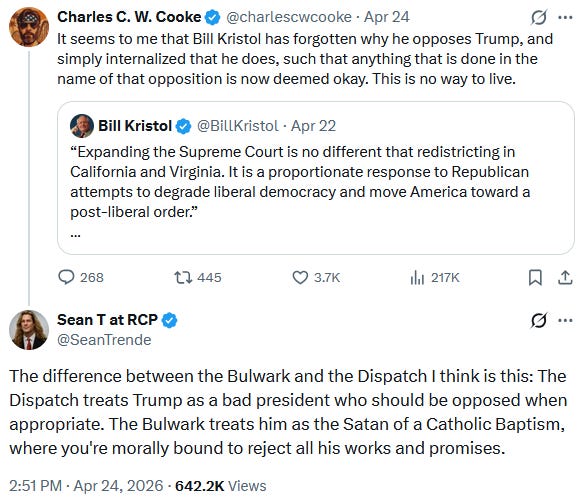
There really wasn’t a reason to drag The Dispatch into the conversation for a Bulwark comparison, other than that MAGA and anti-anti-Trumpers hate both of them for being critical of Trump, and like to pretend they’re basically the same (which is very much false).
Anyway, very broadly speaking, I think Sean was right (his post went viral). And people at The Bulwark actually agreed with him:
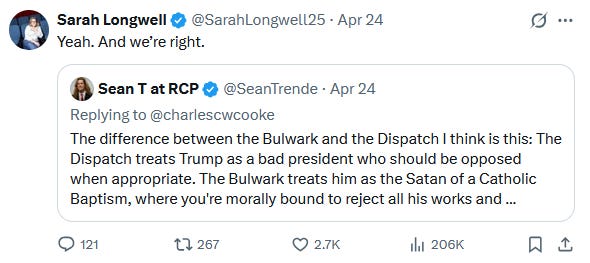
I also mostly agree with your assessments, Aylene, of the three publications mentioned. I’ll just add a couple of things:
I like (and am friendly with) some of the people at The Bulwark, but a number of their commentators sound like Democratic hacks in their reflexive opposition of Trump. If one has to change their position on an issue, just to get on the opposite side of it as Trump, their argument lacks principle and credibility. A lot of people may not care about those things, but I do.
Regarding Jeremiah Johnson (who’s been a Dispatch contributor for some time), he’s indeed a centrist Democrat whose focus is on restoring sanity to his party — including calling out its extremists. He’s kind of an independent outlier, which I think attracted The Dispatch to him in the first place. Thus, his position on Piker doesn’t surprise me at all. I hadn’t heard about his position on Platner, which I’m confident no one else writing for The Dispatch shares.
As I’ve stated many times, from a conservative point of view, I think The Dispatch does the best job of the three media organizations.
Sir John — Seattle Mayor Katie Wilson’s policies seem to be what spurred on the Starbucks Empire exodus from Progressive Leftist Seattle to Conservative Nashville Tennessee. I don’t know how many Starbucks bigwigs and employees voted for Katie Wilson, but for those that did, what the hell did they expect would happen after she gained power? For that matter, what the hell did Mayor Katie Wilson expect that Starbucks and other businesses would do because of her policies? For the record, I’m not a fan of Starbucks OR progressive politicians, but I can’t help relishing the schadenfreude when I see progressive leftists reaping the curses of their own short-sighted foolishness. Your thoughts? — “Starbucks Liberal Latte Tears” regards from The Emperor
Like you, Emperor, I don’t care much about Pacific Northwest politics or Starbucks coffee. If a business environment becomes too difficult in a particular region or municipality, I’m all for private businesses moving to friendlier ones. My hope, whenever something like this happens, is for governing bodies to learn a lesson from it and change public policy. And if they don’t, my hope is for constituents to vote them out of office and elect leaders who will. Unfortunately, in these big-city strongholds, that rarely happens. Some of the most hardened ideologies are disconnected from considerations of success and failure. It’s very weird, but it’s sadly the reality. Decline is often a choice.
In regard to your Rubio column and your question about whether the MAGA base would support him in 2028, I’m seeing many of them online say they would. I know that’s not concrete evidence of anything, and don’t know if they’d still feel that way two years from now. Something funny though: When I ask these people what was wrong with Rubio in 2016, they say “he wasn’t ready yet.” And Donald Trump was??? — Alex D.
Alex, I’ve been running into that exact same thing online. It’s as if they’re all reading from the same script, and you’re right to be amused by it. Rubio was by no means perfect in 2016. He tripped up a few times in his campaigning. But good grief, he’d been a U.S. Senator for five years, served on multiple important committees, and may have had the strongest grasp of issues and policies of anyone who ran that year. Trump, on the other hand, knew nothing about governance or public policy, and often spoke nonsensically (albeit defiantly) about both. He won the nomination largely on insults, attitude, and his celebrity persona. The notion that Rubio was a novice in comparison is absurd.
Thanks everyone! You can send me questions for next week by leaving a comment in the comment section.
Another great session. Keep up the good work.
The support for Rubio has more to do with who else might be on the ballot. There is no current potential candidate that would seem a better choice.