


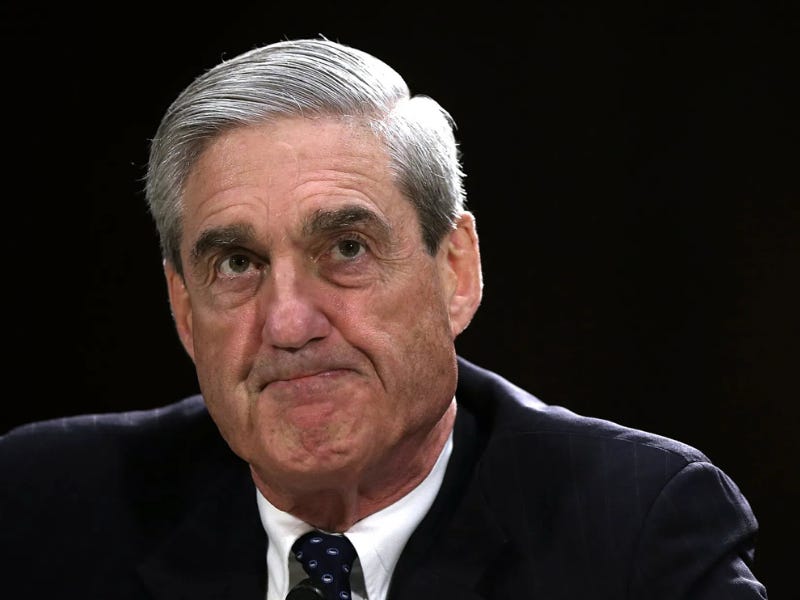
Over the weekend, after a five-year battle with Parkinson's disease, Robert Mueller passed away at the age of 81.
Mueller was a longtime public servant, who held a number of high-profile federal-government positions throughout his impressive career, including as our sixth director of the FBI (from 2001 to 2013). As former President George W. Bush stated in remembrance, Mueller, who took the helm a mere week before the 9/11 attacks, transitioned the bureau’s mission to protecting the homeland, and helped prevent another terrorist attack on U.S. soil.
As a young man in 1968, Mueller, a recent Princeton graduate at the time, volunteered to fight for our country in the Vietnam War. He was so committed to serving in the theater that he waited a year for a knee injury to heal, so that he would be accepted into the military. A U.S. Marine Corps officer, he led a rifle platoon and earned a Bronze Star, a Purple Heart, and two Navy Commendation Medals.
Mueller was married to his one and only wife, Ann, for 60 years. They had two daughters and three grandchildren.
On Saturday, shortly after the announcement of his passing, and the beginning of his family’s mourning, President Trump publicly celebrated Mueller’s death.
“Good, I’m glad he’s dead,” Trump posted on social media. “He could no longer hurt innocent people!”
Lots of observers (including Trump supporters) expressed shock at the incredibly callous statement, but it’s hard to imagine anyone was truly surprised. This is what Trump does. This is who he is. In his mind, anyone he perceives as an adversary is neither worthy of respect nor basic human decency — even in death. The same goes for their families.
“This is the kind of stuff Trump does that makes people not just oppose him but hate him,” remarked Fox News’s Brit Hume. “There was no need to say anything.”
Indeed there wasn’t, but as we saw with John McCain, Donald Trump (who sought and received five draft deferments during the Vietnam War era — including one for bone spurs) seems to hold a particular animus toward “adversaries” who are widely recognized as patriots and war heroes.
Of course, it shouldn’t really matter why our president didn’t like Robert Mueller — not for this discussion, anyway. Trump doesn’t have (nor is he expected) to like anyone he doesn’t want to. But for the sake of many Trump loyalists — those who feel inclined to rationalize anything and everything that comes out of our president’s mouth or keyboard (as they’re doing again this time) — it’s probably worth noting what, exactly, was behind Trump’s beef with Mueller.
From 2017 to 2019, Mueller led the special counsel investigation into Russian interference in our 2016 election. The investigation included (but was by no means limited to) possible collusion between Trump, Trump associates, and the Russian government.
Contrary to popular MAGA belief, Mueller didn’t start the investigation, create the special counsel, or seek to lead it. The investigation had been ongoing for months before Mueller’s involvement, conducted by the FBI under the leadership of the Trump Justice Department. Deputy Attorney General Rod Rosenstein, who was appointed by President Trump and confirmed by the Republican-led Senate, was compelled to create the special counsel in response to Trump's controversial firing of FBI Director James Comey. Rosenstein assigned Mueller to lead the team.
Mueller had a sterling reputation, and his appointment received broad bipartisan support at the time, including from high-profile MAGA cheerleaders like Newt Gingrich. But Trump, likely motivated in part by the reckless assurances of liberal pundits and Democrats that Mueller would indict Trump at any moment, made Mueller his enemy. He publicly smeared Mueller at every turn, insisting that he was a vindictive, anti-Trump partisan who was running a corrupt investigation with the sole purpose of taking him down. Trump and his loyalists declared the probe to be illegitimate, and a vicious attack on our very democracy.
But as it turned out, Mueller effectively exonerated the president. He concluded there was insufficient evidence showing collusion between Trump and Russia, as well as insufficient evidence to charge Trump for obstruction. Mueller did unearth other criminal wrongdoing related to Russian inference, and got indictments, convictions, and guilty pleas from 34 people and three companies.
In the wake of the final report, Trump himself, to the surprise of many, even praised Mueller for doing an honorable job (before turning on him again shortly after).
The Durham Report later identified abuses and biases within the FBI that had improperly altered the scope of the original investigation, but again, that had nothing to do with Mueller. He came in later.
But the fact that he came in at all is why Trump hated the man. Mueller had the gall to step up and serve his country, when called upon, in a way that Trump didn’t like. Thus, he remained a villain to the president and MAGA-world until his dying day (and beyond). To a certain type of person, adding to the pain of that man’s family, while they grieve their loss, is not only understandable but entirely defensible.
Donald Trump is demonstrably that type of person, but you don’t have to be.
I read Trump's quote last week and just cringed. I know it's classic Trump, and we should be used to it by now, but maybe I'm happy I'm not used to it.
The easiest thing in the world for Trump would have been to not say anything at all, but he simply cannot help himself. This a deranged person.