

Daly: Why I Don’t Mock Those Worried About a Third Trump Term
One doesn't have to subscribe to the conclusion to recognize the concern.

Unlike many frequent critics of our president, I don’t think Donald Trump will try to interfere in the midterm elections next year. I also don’t think he’ll remain in office on January 21, 2029 — something a lot of people are genuinely concerned about. But I’m also not going to mock (or otherwise discount) those who are worried about either. That’s because, at minimum, I understand their fears.
I’ve told a story a few times on this website about an email exchange I had with a nationally-recognized political commentator — a friend of mine — shortly before the 2020 election. She saw me downplaying, on Twitter, the notion that Trump would try to stay in office if he lost the election. She wasn’t as convinced as I was, and laid out a few scenarios in which Trump may try to use the expected delay in mail-ballot counting to further push the narrative (he’d been shaping for weeks and months) that the Democrats would try to steal the election.
I wasn’t oblivious to Trump’s rhetoric on the matter, of course. He had said pretty much the same thing in 2016, first during the primaries (when he was accusing GOP state parties of cheating), and later in the run-up to the November election. Even after he unexpectedly defeated Hillary Clinton, he falsely claimed that he had also won the popular vote, and accused the Democrats of falsifying the numbers. But as corrupt as I knew Trump to be then, and over the next four years, I still had trouble picturing him actually trying to cancel the results of a national election to stay in power. Heck, I wasn’t even convinced that he would deny his loss, and continue to do so for the next two months (let alone the next five years).
But… I was wrong. My friend was right. Trump, on multiple fronts, did try — very hard, in fact — to overturn U.S. democracy. He tried to strong-arm election officials into changing the election results and refusing to certify the votes, targeting them publicly (for harassment and threats from his supporters) when they wouldn’t comply. He did the same thing with judges (some of whom he’d appointed himself) who threw out his frivolous lawsuits. He put immense pressure on his own vice president, and a largely compliant Republican Congress, not to certify the election. He twisted the screws even tighter by summoning thousands of riled-up supporters to the U.S. Capitol on January 6, which led to a deadly insurrection. Members of Trump’s legal team tried to block the certification with legal maneuvering, while fake slates of electors were submitted on Trump’s behalf. Trump even told his DOJ to publicly declare the election corrupt (and let him do the rest), a move that prompted his attorney general to resign.
Did it work? No. And frankly, I was never worried it would. But if not for a few individuals holding the line, in the right places and at the right time (like Mike Pence and Bill Barr), we likely would have had a full-blown Constitutional crisis on our hands. Though that didn’t happen (and thank goodness for that), the damage caused to our nation was still significant. Lives were ruined. Livelihoods were destroyed. Officials feared for themselves and their families. The U.S. Capitol was desecrated. Millions of Americans lost trust in our system of democracy. And without sufficient accountability for all that happened, political corruption and even political violence were normalized on a level I never thought possible.
So, when I see even people that I respect (and often agree with) belittle those who are worried about Trump trying something similar in the future (like esteemed legal scholar Robert P. George recently did), I’m not inclined to nod along.
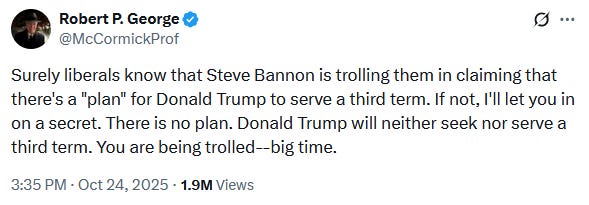
In fact, I think it’s borderline irresponsible not to even consider the possibility of such an effort… even if you don’t believe it could possibly be successful. As noted, there’s a lot of damage that can be caused to the fabric of our nation, and our constitutional order, without actually circumventing the U.S. Constitution. And what we’ve seen over the last ten months from the executive branch, just in regard to the 2020 election alone, should send up more warning signals than assurances of the institutional strength of our system.
By the time Trump returned to the White House earlier this year, just about every elected Republican official, who’d tried to hold him accountable for his actions four years earlier, had been purged from office (largely at Trump’s direction, and with his involvement). The administration has since fired or otherwise forced out numerous officials (including FBI agents and DOJ prosecutors) who worked on January 6 cases and other investigations related to Trump. The administration has likewise gone after law firms representing such people.
One of Trump’s first actions in his second term was to grant pardons to more than 1,500 criminals who were part of the January 6 attack, including hundreds of individuals who assaulted police officers. And just this week, Trump pardoned a long list of individuals (including Rudy Giuliani, John Eastman, and Sidney Powell) who helped him try to overturn the 2020 election.
This goes well beyond making a mockery of our system of law and order (which Trump still claims to be a champion of)... It sends a loud and clear message that anyone who breaks the law at Trump’s behest, or in his name, will likely receive a “get out of jail free” card. And those who uphold the law at Trump’s expense? They’ll pay a terrible price for doing so.
So, is it really all that weird for those who’ve been paying attention to be concerned? I mean, I think it’s pretty clear that from November 3, 2020 to January 20, 2021, there were far more people in key government positions willing to defend the Constitution and rule of law than there are right now. And as last year’s election proved, a near majority of American voters don’t find such violations disqualifying for public office.
Now, I certainly disagree with those framing future election-interference by Trump as a foregone conclusion. Their concerns may be valid, but their certitude is not. Still, what saddens me most on this issue is that I think the most compelling argument for why Trump won’t screw with our upcoming elections has nothing to do with the law, the Constitution, or other institutional guardrails. It has to do with a presumed personal lack of interest on Trump’s part.
I’ve long argued that Trump doesn’t care much about the make-up of Congress (beyond ridding it of insufficiently loyal Republicans). He doesn’t have a legislative agenda, and would much rather govern through executive actions and performative gestures. I think he’s largely indifferent to whether the Democrats will win back a branch of Congress (or two) in the 2026 midterms. Heck, if the Dems get some power back, it will be easier for him to blame them for things.
As for the 2028 presidential election: Trump will be 82 years old by then, and his health will assuredly become of greater concern. He’s already escaped criminal prosecution by winning a second term, which he’ll likely cap off with an all-inclusive self-pardon. Between cryptocurrency and other business-ventures bolstered by his presidency, his net-worth has skyrocketed over the last year to an estimated $7.3 billion (almost double what it was when he first ran for president). The odds, I think, are that he’ll be mentally and physically ready to hang it all up by then, and relegate himself to being a kingmaker in the Republican Party (where he’ll continue to enjoy undue power and slobbering praise).
I think that’s the most likely scenario, which is primarily why I’m not worried about things going off the rails in an assuredly futile attempt to stay in power.
Then again, I wasn’t worried in 2020 either.
Guys like Trump are unable to recognize in themselves the frailties that come with age. To the day he dies he will see himself as 10' tall, bulletproof and never wrong regardless of overwhelming proof to the contrary. I can't see him giving up his power, even from behind a curtain, without an "at all costs" fight. His type has also been known to also become a Nero rather than let someone else take over. Good God I hope I'm wrong!
‘I’ve long argued that Trump doesn’t care much about the make-up of Congress (beyond ridding it of insufficiently loyal Republicans).” I have been saying the same thing for a long time … all Trump cares about is … Trump. Well written, John. Aloha, Mike